
(Read time: approximately 4 minutes.)
I was speaking to someone just this week who said to me, “I don’t know how a Christian can vote for a Democrat.” It is hardly the first time I have heard that sentiment expressed. Yet I know other people who express disbelief that a Christian can vote for a Republican—or at least for a particular Republican.
I think our assumption is that Jesus would vote the way we intend to vote if he were in our place. If we are liberals, we have a liberal Jesus who takes care of the oppressed even when it is costly. If we are conservatives, we have a conservative Jesus who maintains high moral standards even when it is not popular.
So, is Jesus a liberal or a conservative? Is he on our side or is he on their side?
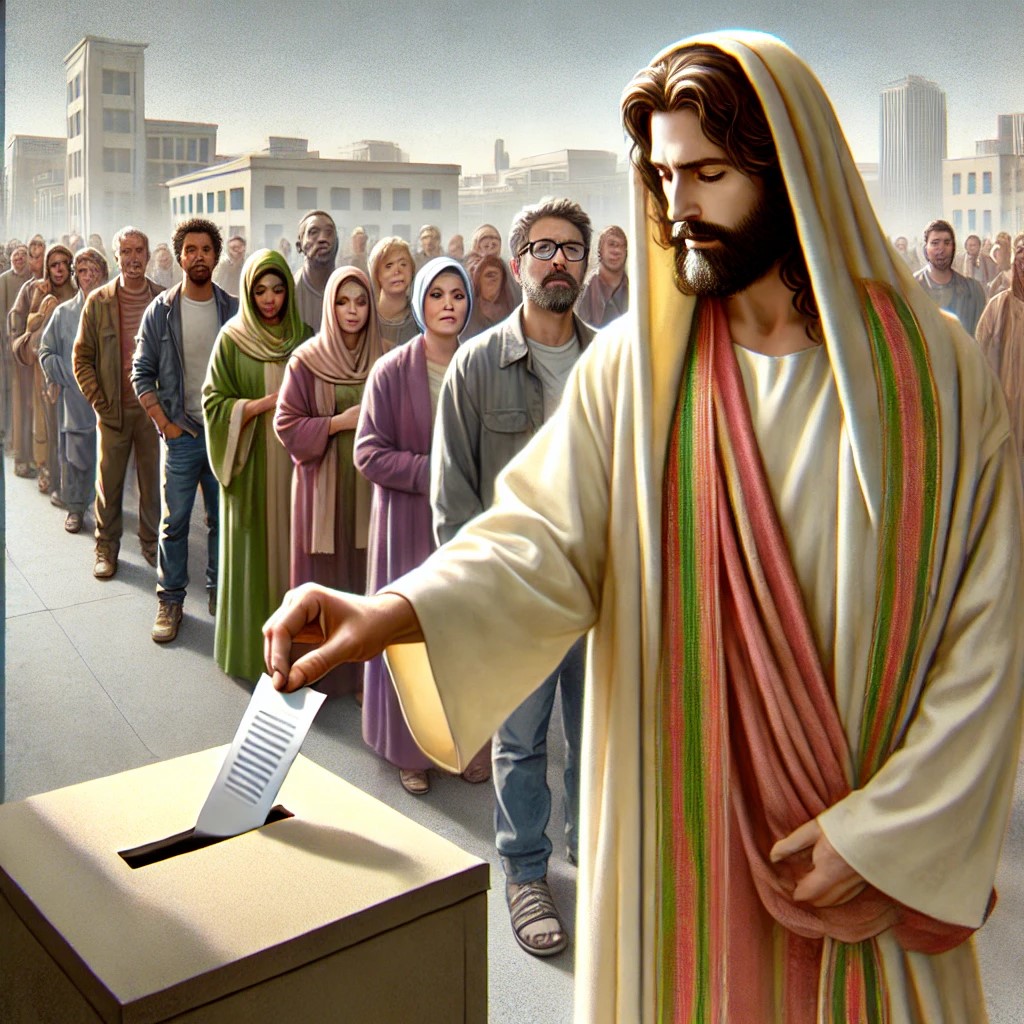
Perhaps we should be asking a different question. Instead of asking if Jesus is on our side, we should be asking if we are on his. Are our values and actions consistent with what we know about Jesus from the Gospels?
There is a fascinating incident in Israel’s history that has bearing on the “whose side is God on” question. The people of Israel had spent 40 years as refugees, wandering from place to place in a barren, mostly unclaimed land. When it was necessary to cross a tract of land that was claimed, they usually faced hostility and sometimes war. After decades of wasting away in the harshest conditions, they were finally poised to enter their own land.
But there was a problem. There were people living there who would not welcome them. They would face adversaries almost immediately who would try to drive them out. As Israel prepared to cross into their new homeland, their leader Joshua encountered a man – he turns out to be “the commander of the LORD’s army” – with a drawn sword. Joshua approaches him with remarkable courage and demands to know: “Are you for us or for our enemies?” The “man” replies, “Neither.”
That is probably not what Joshua wanted to hear, but it was what he needed to hear. The question was not then, nor is it now, whether God is on our side. The question is whether we are on his. Until Christians get that right, whatever choice they make in the voting booth will be wrong.
When it comes to the question of whether Jesus is a conservative or a liberal, I think there is evidence for both, but there is no evidence that he is a Republican or a Democrat. He calls Republicans and Democrats to join his side. He will not join theirs.
There is only one miracle story (besides the resurrection) that appears in all four primary accounts of Jesus’s life: the story of the feeding of the 5,000. In the story, Jesus takes his closest followers away for a private retreat, but the crowds discover their destination and meet them there. Jesus feels compassion for them, teaches them, and heals those who are ill.
Late in the afternoon (Greek is more picturesque: “The day had begun to recline”), Jesus’s apostles told him to “Send the crowd away…so they can find food and lodging, because we are in a remote place.” Obviously, they had been thinking about this and assumed that Jesus, busy as he was, had not. Nevertheless, it is probably not wise to tell the Lord what to do.
Jesus, like a true liberal, had compassion on the crowd. Instead of telling them to fend for themselves like responsible adults, he told his team to feed them. Rather than getting busy with that, the team explained to Jesus why it couldn’t be done. It is probably not wise to tell the Lord that something he chooses to do can’t be done.
When it comes to Jesus, where there is a will there is a way. He proceeded to feed the crowds so that everyone was satisfied. Then, like a true conservative, he told his team to “gather the pieces that are leftover. Let nothing be wasted.”
When conservative Christians complain about liberals, it is rarely because they are liberal. It is usually because their party advocates for issues like abortion, gender transitioning, and the abolition of police departments. These are not liberal positions, even if many “liberals” support them. (However, contrary to media propaganda, polling reveals that few liberals want to abolish the police.)
When liberal Christians complain about conservatives, it is rarely because they are conservative. It is usually because their party opposes compassionate immigration laws, ignores historic injustices, and elevates one race above others. These are not conservative positions, though they are positions that many “conservatives” take.
As a Christian, I want to be liberal in the sense that I want to be openhanded with my (not someone else’s) resources. I want to welcome the oppressed and feel compassion for those who are different from me. I also want to be conservative in the sense that I conserve what is good, whether morality or resources or the God-given gifts and insights of people who are not like me.
It seems necessary to me to reject liberalism as a political doctrine while treating people with liberality and reject conservatism as a political doctrine while conserving all that is just and good.
Liberalism or conservatism is a false dichotomy for a Christian—a fool’s choice. Instead of standing on an “ism” – any “ism” – let the Christian follow the way of Christ. He did not tread some middle way, like Aristotle’s golden mean, but ascended to the summit of love. It is ours to follow him there.


 The Way Home