
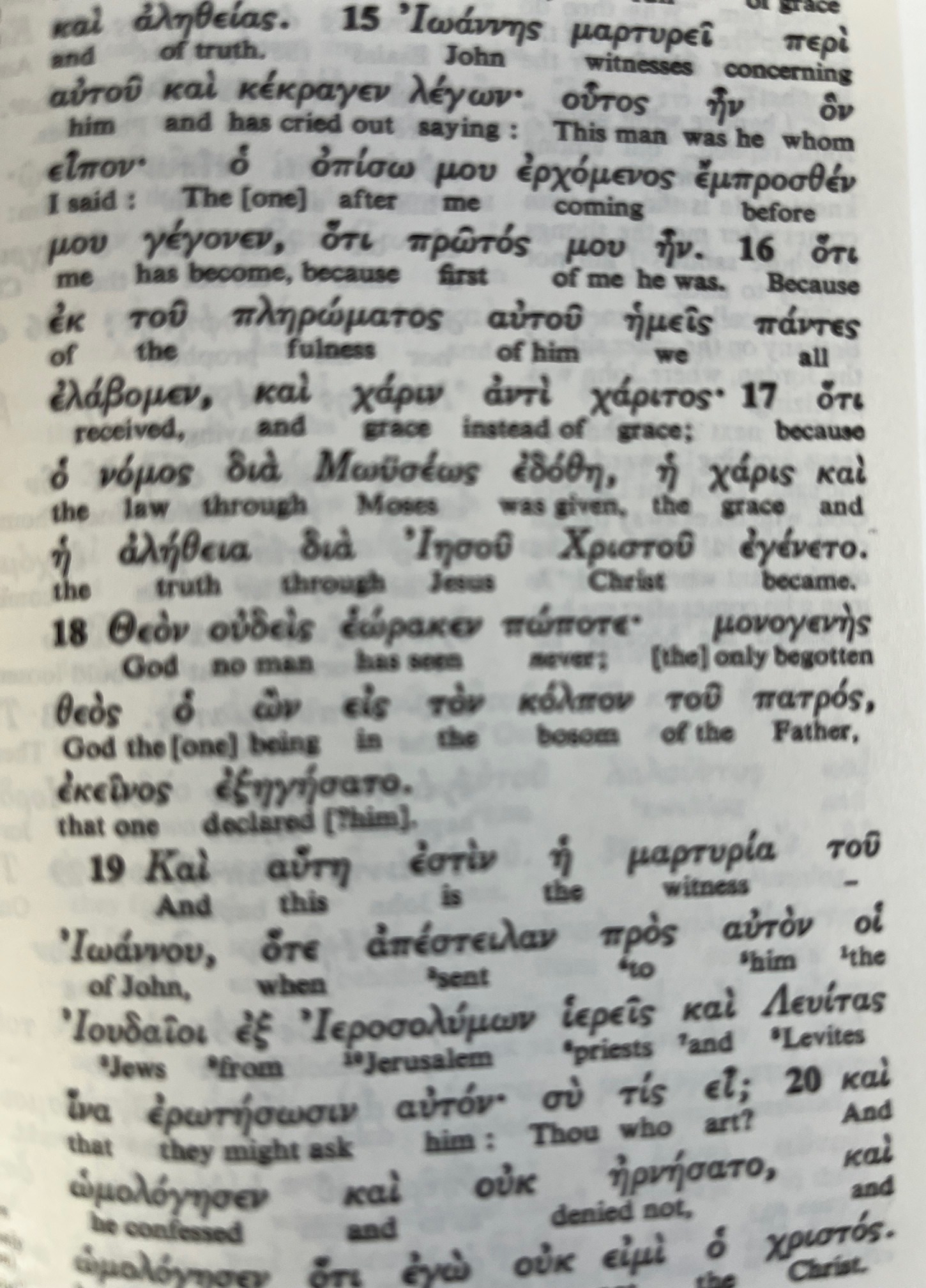
I meet with a small group of men who are reading through major sections of Scripture together, and today’s reading had me in John 1. I sat for a long time, seeing significance in every line, almost in every word. Verse 18 (literal translation), “No one has ever seen God; God Only Begotten, the one existing in the Father’s bosom, has interpreted him,” made me think of Jesus as a kind of Divine-Human interlinear, who enables us who could never otherwise make sense of God, to know him.
Earlier, in verse 14, John wrote, “We have seen his glory, the glory of the one and only Son, full of grace and truth.” What was John thinking about when he wrote, “We have seen his glory”? When did John see his glory?
Of course, there were many times when Jesus displayed his power—walking on the stormy sea of Galilee, calming the wind and waves, healing the sick, transfigured on the mountain. But these do not seem to have been uppermost in John’s mind. As many scholars have noted, it is not of Jesus’s power that John thinks, but his remarkable humility. Born in an animal’s stable, laid in a feeding trough, turned away from the inn. He would later say that, while foxes have holes and birds have nests, he had no place to lay his head. Near the end of his Gospel, John borrows that last phrase verbatim (though in English it is translated, “He lay down his head”).
So, Jesus finally found a place to lay his head! He was moving up in the world at last! Yes—up a cross. For John uses that phrase it is in this context: “Jesus said, ‘It is finished.’ With that, he bowed his head” – “he lay down his head” – and gave up his spirit.” The only place he found to lay down his head was on an executioner’s cross. He spent his earthly life in a backwater province of the Roman Empire, doing manual labor, then preaching to poor people, often in rural (and sometime remote) areas. So where is this glory that John claims to have seen?
We don’t see it because we think of glory as glitz and hype and notoriety. Glory, in our minds, is being selfie-stalked on the street, going viral on social media, entreated for interviews and autographs. Glory is Pomp and Circumstance and Hail to the Chief. But this is not what John sees.
John sees the Ancient of Days willingly imprisoned in time, the omnipresent one enfleshed in a body, the Holy One nailed to a cross, bearing our sins. Real greatness doesn’t hunger for praise. When it sees something that needs to be done, it does it. It leaves the exalted place, performs the necessary deed.[1] On the night of his betrayal, when Jesus prayed for the Father to “glorify the Son,” his prayer found its answer not high on a dais before an adoring crowd, but high on a cross before a jeering mob. Instead of defiantly pumping his fist before a multitude, he submitted to having his hands nailed to a cross. This, John realized, is his glory, and it shines like a halo around the cross.
There is one more thing to note. Though his glory was misunderstood and his own rejected him, there were some who received him. Back in verse 12 John wrote: “Yet to all who received him, to those who believed in his name, he gave the right to become children of God.” In every generation, there have been those who welcomed him, believed in him, and by faith received him. They become children of God, and receive a new kind of life.
That new kind of life opens up a new way of life. It does not replace physical life but envelops it. It begins to change those who have it, replicating Jesus’s life in them (doesn’t that sound like something from a Michael Crichton novel?), so that they begin to think as he thought and live as he lived. As they are conformed to his image, they become a kind of interlinear themselves, enabling people to know Jesus.
[1] See Leon Morris, “Expository Thoughts on the Gospel of John,” Grand Rapids: Baker Books © 1986. P.23


 The Way Home