
(Plus a fun skit for your enjoyment.)
In Matthew 28, Mary Magdalene and the other Mary leave early on Sunday morning to see (“watch,” “observe”) Jesus’s tomb. But they are not the only ones watching it; so are the Roman soldiers, lent by Pilate to the chief priests so they could “make the tomb as secure as” they knew how.
This is only one expression, and the least obvious, of the parallel lines of storytelling by Matthew in chapter 28. The twin storylines follow the women and the guards, and it seems to me that Matthew structured his narrative this way on purpose.
An angel appears to the guards and they “are afraid of him” – so afraid that they shake uncontrollably and become “like dead men.” The women are also afraid of the angel. (Matthew does not tell us this but Mark and Luke do. Matthew does mention that the angel tells the women, “Do not be afraid.”)
The women go off to the city following their encounter with the angel. So do “some of the guards.” In fact, Matthew explains that while the women are on their way, the guards, recovered from the shock and paralysis of meeting an otherworldly being, go off to the city themselves.
The women go to report (Gk., ἀπαγγεῖλαι) to the disciples all they had seen and heard. While they are doing that, the guards deliver their report (ἀπήγγειλαν) to the chief priests. Both the women and the guards have news to tell, and they tell it. The guards are then paid “a large sum of money” (where the word is the same one used of the blood money Judas received).
By framing his narrative with these parallel storylines, Matthew is able to subtly demonstrate the ways different people respond to the gospel. (That word comes from the same root as the word used of the news the woman and the guards reported.) The women hurry to tell the good news to those who had not yet heard and, as they go, they were met by Jesus himself.
“Some” of the guards also carried news into the city to those who had not heard, but they did not meet Jesus. While the disciples eventually realized that the women’s report was very good news – was “gospel” – the chief priests considered the news the guards shared to be very bad news. Though they knew it was true, they did not want anyone to believe it.
Those are the parallel storylines we see in Matthew 28. If readers have noticed other parallels I have missed, I’d love for you to share them with me!
I have wondered why Matthew mentions specifically that “some” of the guards, and not all, went into the city. I can think of other reasons to account for it, but I’d like to think that some of the guards had made up their minds not to have in more to do with guarding priestly lies. I once wrote an Easter morning skit that features two such members of the guard (Gk, κουστωδίας) and what might have become of them. I include it for your entertainment.
************************
If That’s True
[Two soldiers stand in front of the tomb at attention, about four feet apart, eyes forward. But they talk to each other, on the sly.]
Soldier One: Nice legs.
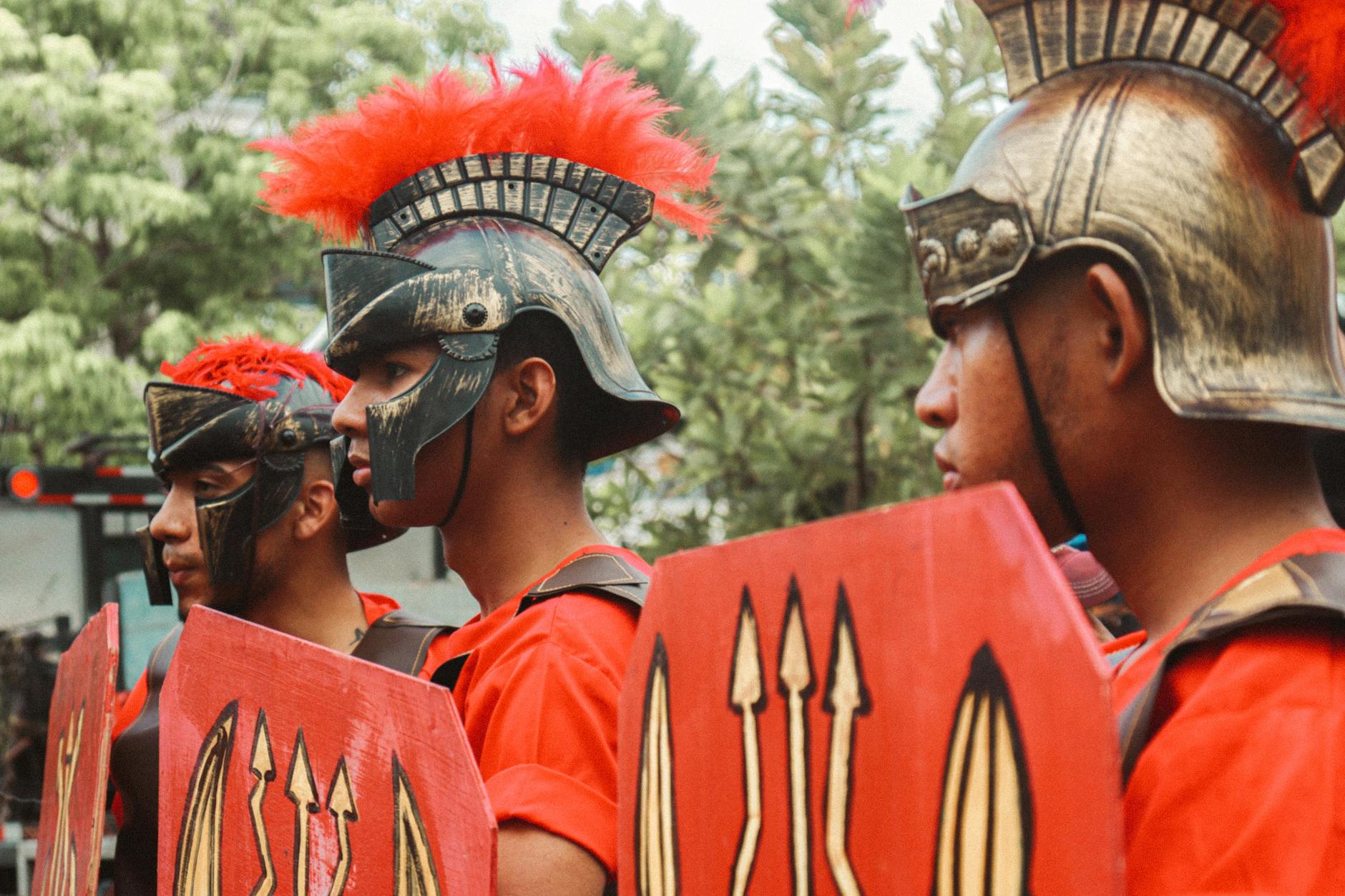
Soldier Two: Shut up.
Soldier One: I hear there were some women here yesterday. Came to get a glimpse of you, I shouldn’t wonder.
Soldier Two: Shut up. [Ten seconds pass]
Soldier One: So, what are we doing here, anyway?
Soldier Two: Following orders.
Soldier One: Yeah, but . . .
Soldier Two: [Interrupting] Centurion’s coming.
[Ten seconds pass in silence]
Soldier One: I mean, what are we doing here, guarding a dead guy? It’s not like he’s part of the imperial family, or something. He’s a Jew, for cryin’ out loud.
Soldier Two: I heard the emperor ordered a twenty‑four-hour guard for his wife’s dead cat prior to its burial.
Soldier One: Yeah, the bigger they are, the crazier they are. But there was only one imperial cat; there’s got to be ten thousand of these Jewish teachers around.
Soldier Two: So?
Soldier One: So . . .
Soldier Two: Quiet! [several seconds pass]
Soldier One: So, what are we doing out here — a koustodia? You don’t need a koustodia to keep a few members of some crazy sect from getting into a tomb. What are they really afraid of?
Soldier Two: Maybe they’re not afraid of people getting into the tomb.
Soldier One: Then what?
Soldier Two: Maybe they’re afraid of someone getting outta the tomb.
Soldier One: That’s crazy.
Soldier Two: Didn’t you hear what the centurion said? This teacher told people he would rise from the dead.
Soldier One: Like anyone’s gonna believe that!
Soldier Two: Seems like somebody did.
Soldier One: What‑da‑ya mean?
Soldier Two: I mean: We’re here aren’t we? A koustodia. Somebody is scared.
Soldier One: You don’t think it could really happen — I mean, after being dead a person could come back to life?
Soldier Two: Maybe. I don’t know. But if Caesar could figure out how to do it, he’d send us into one battle after another till we’d taken the whole bloody world. Nobody could stop us.
Soldier One: Yeah. But what I was thinking was that if you and I couldn’t die, I’d have to see those ugly legs, day after day, forever.
Soldier Two: Shut up.
—————————
(A long time has passed. The soldiers are now dressed in civilian clothing.)
Soldier 1: Legs?? What are you doin’ here? Come back to the scene of the crime, eh?
Soldier 2: [Surprised] Valerius, why aren’t you in uniform? What’s happened?
Soldier 1: [Shrugs] I served my 20. Got my citizenship. It was time to get out. But what about you? You’re not in uniform either.
Soldier 2: [Bitterly] I’m out too. The day I joined the Koustodia was the proudest day of my life. But when that old priest told us to lie, and the Commander backed him up—I felt ashamed of being a Koustodian. [Pauses.] I should’ve told the truth.
Soldier 1: They would’ve killed you. Besides, what is the truth? I still don’t know what happened.
Soldier 2: You know we didn’t fall asleep. You know we didn’t fail in our duty. You know a gang of fish-catchers and tax collectors didn’t steal the body.
Soldier 1: Yeah, I know all that. [Looks around.] But did anyone steal the body? I mean, it seems like no one went into that tomb, but … somebody came out.
Soldier 2: Are you saying what I think you’re saying? Because if that’s true …
Soldier 1: [Interrupting.] If that’s true, Legs, this Jew they set us to guard knows how to charm Cerberus and walk right out of Hades. But how? That’s the question. How’d ’e do it?
Soldier 2: I’ve been thinking that those fish-catchers and tax collectors might know—I heard the priest call them his disciples. Maybe he taught them how. I think I’d like to find one of them and ask him. Want to go with me?
Soldier 1: Sure. But, uh, just be careful those fish-catchers don’t catch us.


 The Way Home