
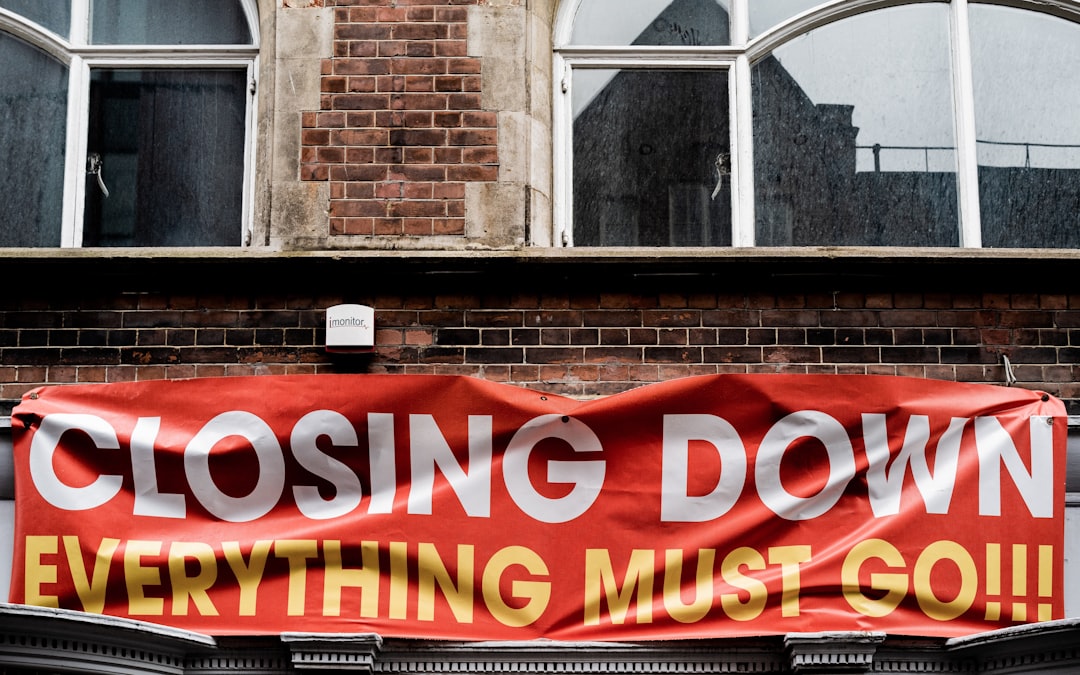
We once lived in a city with a furniture store that was always going out of business. Its windows were plastered with signs that said things like, “Everything Must Go,” “Drastic Markdowns,” “Liquidation Sale!” and of course, “Going Out of Business.” The odd thing was that the store didn’t go out of business. It kept selling furniture and (I suppose) buying new furniture for years.
I took a class on The Epistle to the Romans when I was in college. I remember our professor, who translated Romans for the NIV back in the seventies, telling us that this word was sometimes used to describe first century stores that had gone out of business. It might be helpful to translate Romans 6:6 that way: “For we know that our old self was crucified with him so that the body ruled by sin might go out of business, that we should no longer be slaves to sin…”
I thought of that store a couple of days ago while reading Romans 6. In the NIV, verse 6 reads: “For we know that our old self was crucified with him so that the body ruled by sin might be done away with, that we should no longer be slaves to sin…” The word translated, “Might be done away with” appears 27 times in the New Testament and is translated in a dizzying number of ways. The NIV alone renders it as “nullify,” “use up,” “is worthless,” “released,” “come to nothing,” “destroy,” “cease,” “pass away” (the latter two in the same verse!), “disappears,” “put behind,” “fading,” “taken away,” “set aside,” and “abolish.” Other versions use still more words to translate it.
“The body ruled by sin might go out of business.” What could that mean? St. Paul seems to think that the body can be used by sin as a center of production or operation. He calls it (literally) “the body of sin,” as if it belongs to sin, is under its management. This is not a necessary state of affairs; it was brought about by Adam’s rebellion (see Romans 5:11-17). Paul sees it as reversible or, better, as already being reversed.
The idea that the body can be used as a production center for sin is elaborated on in chapter 7, especially in verses 8-19. Sin, as anthropomorphized throughout chapters 6 and 7, has over eight billion production centers currently in operation—that’s even more than Dollar General! But God has a plan for shutting them all down, including the tall, aging one that goes by the name Shayne Looper.
That plan involves the creation of a transtemporal link between us and the Messiah in his death. In that way, “our old self” could be “co-crucified with him” (verse 6). Apparently, the only way to shut down the business is to do away with the local franchise operator (for example, me). That transtemporal link, which is accessed by faith, takes us into Christ’s death and makes it possible to shut down the body of sin permanently. It also takes us into Christ’s resurrection, making it possible to reopen under new management, with a different product line (righteousness instead of sin), and a happy workforce.
All of this is made possible by Jesus’s death and resurrection and is made real by our trust in him. But if it that is so, why have we not yet fully experienced the “closure” of the “body ruled by sin?” Why has the “Going Out of Business” sign been in the window so long?
The new owner has given each of us the responsibility of closing down the business of sin that has been operating in our bodies. We do this as we consider ourselves (that is, act as if we truly are) dead to sin. But this, by itself, is not enough. We must also stop presenting the parts of our body to sin, which happens when sin has become a habit. No wonder it takes so long to go out of business.
There is yet another step. We need to launch the new business even before the old has vacated the premises, or it will never leave. So, Paul tells the Romans to “offer the parts of your body to [God] as instruments of righteousness.” Think of a vast building which the previous owner sublet to hundreds of sleazy businesses—all pushing junk at exorbitant prices. But under the new owner, we are authorized to expel all these trash peddlers and replace them with makers of quality, helpful goods.
Like the furniture store in our former city, the “Going Out of Business” sign has been up for a long time in my life. But unlike the furniture store, “the body ruled by sin” really is going out of business. It has been purchased by Christ and is increasingly coming under his control. I know the day is near when the sign will come down for good.
At present, a soft launch under the leadership of the new owner is underway, and it is going well. Just think what the hard launch, the Grand Reopening, will be like, when the Lord Jesus “will transform our lowly body to be like his glorious body” (Philippians 3:20-21)!


 The Way Home