
“Think of yourself just as a seed patiently wintering in the earth; waiting to come up a flower in the Gardener’s good time, up into the real world, the real waking.” (C.S. Lewis, Letter to Mary Willis Shelburne, June 28, 1963. The Collected Letters of C.S. Lewis, Volume III.)
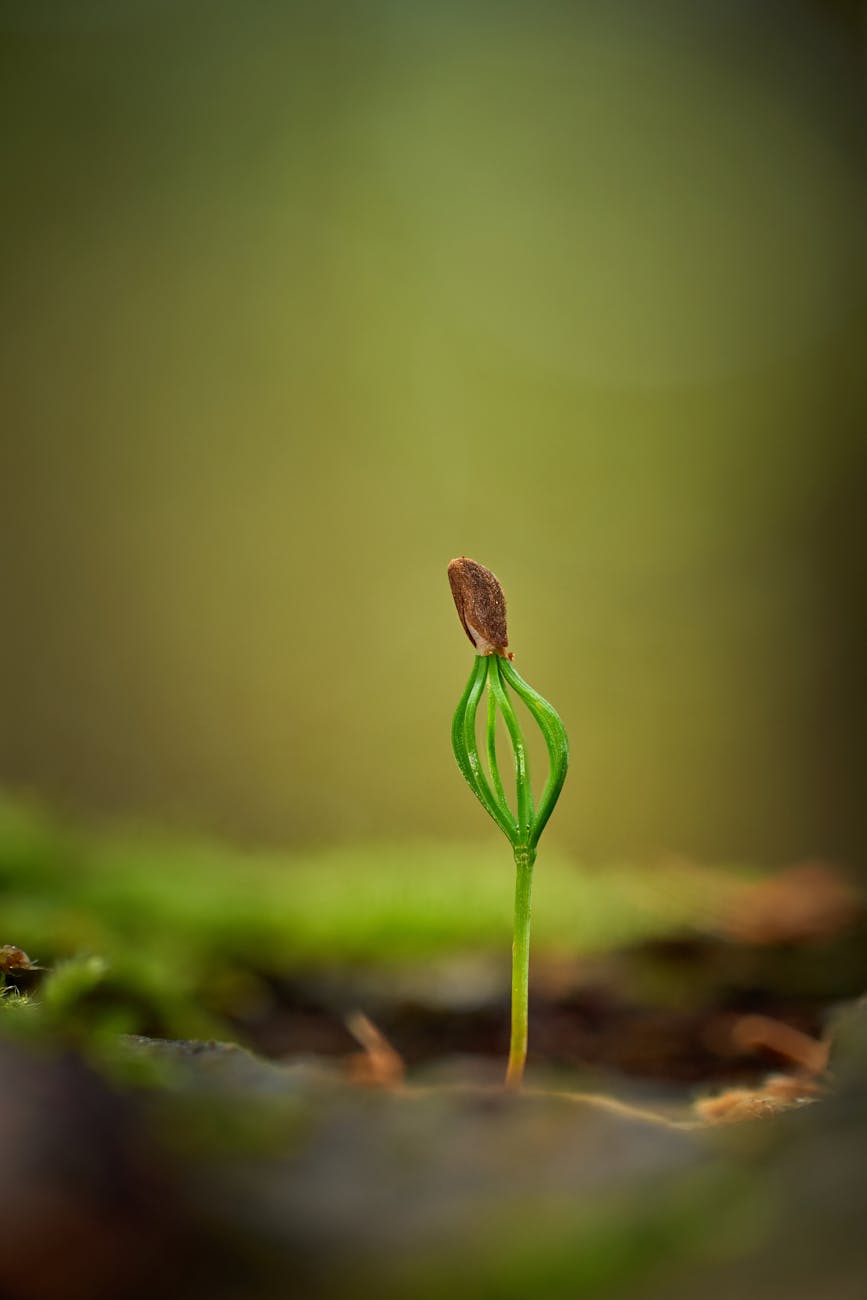
What will people be like in the age to come? Will they eat and drink? Will they need to? Will they play (tennis, chess, basketball, pinochle)? Will they fish, hike, and hunt morel mushrooms? Will they paint, write music, and make love? Or will they, Star Trek-like, be giant brains in jars filled with some chemical preservative, experiencing life through some advanced virtual reality technology?
Were we to ask St. Paul these questions, I know what his answer would be: “How foolish!” for that is how he answered these kinds of questions in the first century. (See 1 Corinthians 15:35-36, where the word Paul uses in not an adjective, as in the NIV, but a nominative case plural noun: “Fools.”) In 1 Corinthians 15, the apostle’s focus is not on what we will be. Like St. John (1 John 3:2), he would probably confess a high degree of ignorance about that. Instead, he focuses on what we will not be.
To make his point, he uses the analogy of a seed alongside its full-grown plant. Had Paul known the story of Johnny Appleseed, he might have pointed out the fact that Johnny planted apple seeds not apple trees. He did not dig large holes in the ground and bury trees, trunks and branches. In Paul’s words, “When you sow, you do not plant the body that will be, but just a seed…” If you want to grow an oak, you bury an acorn in the ground, not a tree.
When God sows, he does “not plant the body that will be,” only the seed. In 1 Corinthians 15, the seed is the analogue, and the Christian is the referent to which it points. Christians are the seeds God sows in this age, but that mature in the age to come. There is a vast difference between the seed (what we are now) and the mature plant we shall be (in the age to come). As Paul later states: “…we shall be changed.” The enormity of that change, which exceeds even the difference between little acorn and giant oak, is beyond imagination.
The Apostle goes further to differentiate between what we are now (seed) and what we shall be (fully mature humans). “The body” – the seed that we now are – “that is sown is subject to corruption, it is raised incorruptible; it is sown in dishonor, it is raised in glory; it is sown in weakness, it is raised in power; it is sown a natural body, it is raised a spiritual body.”
When you read “spiritual body,” do not think of a body composed of spirit. A spiritual body is more like an electric car than it is like a brick house. It is not made of spirit, like a house is made of brick, but it is powered by spirit, like a car is powered by electricity. The word translated “natural” in 1 Corinthians 15:44 supports this conclusion. It is an adjectival form of the word “soul.” Paul’s point is that the body/seed that God plants in this age is powered by this age’s natural energy source (the soul), but when it is raised, it will be powered by spirit.
What could bring about this remarkable? Paul’s answer to that question becomes clear in verse 45. The “first man Adam” was created to be a “living soul,” but the “last Adam” was incarnated to be a “life-giving spirit.” This “last Adam,” the “second man” who is “from heaven,” has become the source of a new kind of humanity, what humanity was intended to be all along, powered by a new kind of life.
But for the new kind of humanity to be realized, a change even greater than the one between acorn and oak is required. What could possibly trigger such a change? Paul’s answer: The resurrection (1 Corinthians 15:51-53). An evolutionary biologist might think that Paul is talking about a type of theological saltation – a sudden, large mutational change occurring in a single generation.
The Christian has a different word for it. What the biologist might call “saltation,” the Christian knows as “salvation.” It is the great God’s good gift to us through Jesus Christ (1 Corinthians 15:57).


 The Way Home
Leave a comment