
I have already posted written excerpts from this sermon (https://shaynelooper.com/2024/10/16/immeasurable-power-ephesians-119-23/). Below is the sermon video. Blessings.
Viewing Time: 23:44.
I have already posted written excerpts from this sermon (https://shaynelooper.com/2024/10/16/immeasurable-power-ephesians-119-23/). Below is the sermon video. Blessings.
Viewing Time: 23:44.
(Read time: approximately 4 minutes.)
I was speaking to someone just this week who said to me, “I don’t know how a Christian can vote for a Democrat.” It is hardly the first time I have heard that sentiment expressed. Yet I know other people who express disbelief that a Christian can vote for a Republican—or at least for a particular Republican.
I think our assumption is that Jesus would vote the way we intend to vote if he were in our place. If we are liberals, we have a liberal Jesus who takes care of the oppressed even when it is costly. If we are conservatives, we have a conservative Jesus who maintains high moral standards even when it is not popular.
So, is Jesus a liberal or a conservative? Is he on our side or is he on their side?
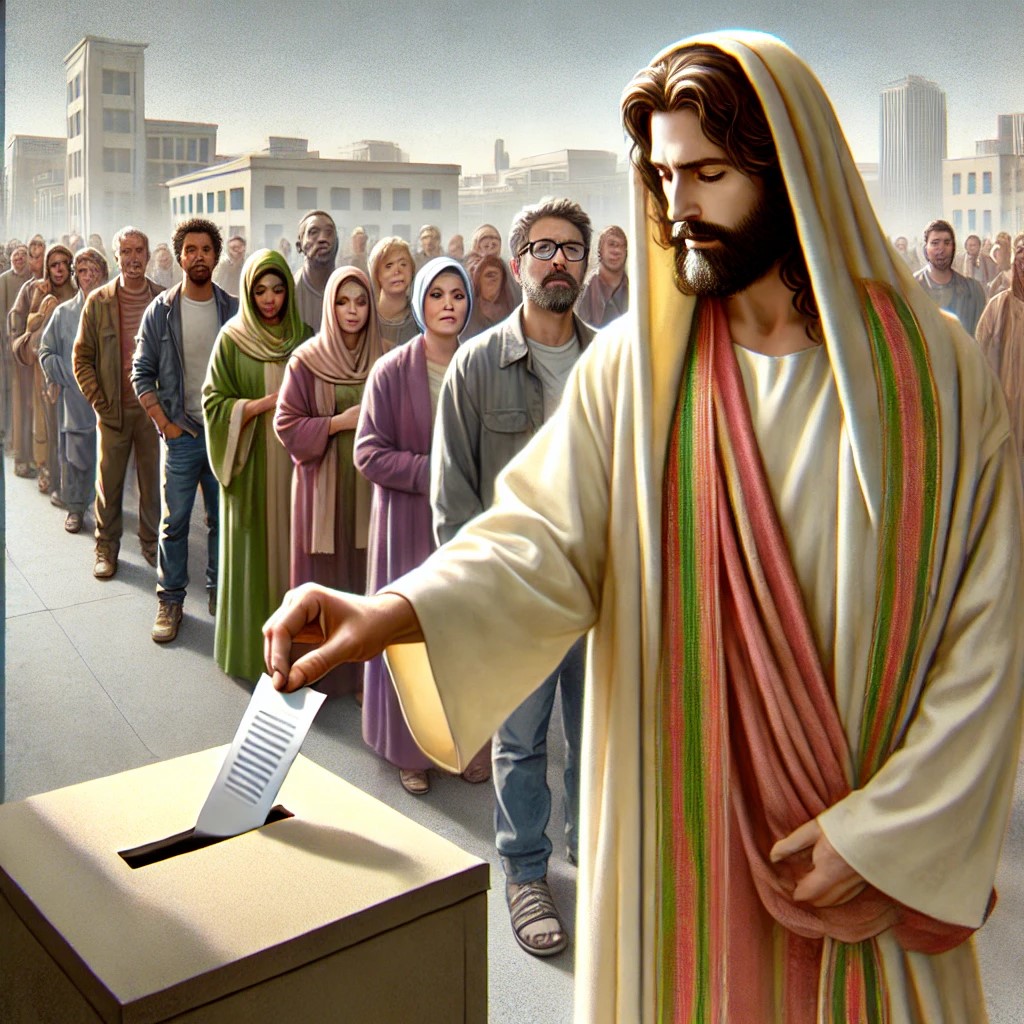
Perhaps we should be asking a different question. Instead of asking if Jesus is on our side, we should be asking if we are on his. Are our values and actions consistent with what we know about Jesus from the Gospels?
There is a fascinating incident in Israel’s history that has bearing on the “whose side is God on” question. The people of Israel had spent 40 years as refugees, wandering from place to place in a barren, mostly unclaimed land. When it was necessary to cross a tract of land that was claimed, they usually faced hostility and sometimes war. After decades of wasting away in the harshest conditions, they were finally poised to enter their own land.
But there was a problem. There were people living there who would not welcome them. They would face adversaries almost immediately who would try to drive them out. As Israel prepared to cross into their new homeland, their leader Joshua encountered a man – he turns out to be “the commander of the LORD’s army” – with a drawn sword. Joshua approaches him with remarkable courage and demands to know: “Are you for us or for our enemies?” The “man” replies, “Neither.”
That is probably not what Joshua wanted to hear, but it was what he needed to hear. The question was not then, nor is it now, whether God is on our side. The question is whether we are on his. Until Christians get that right, whatever choice they make in the voting booth will be wrong.
When it comes to the question of whether Jesus is a conservative or a liberal, I think there is evidence for both, but there is no evidence that he is a Republican or a Democrat. He calls Republicans and Democrats to join his side. He will not join theirs.
There is only one miracle story (besides the resurrection) that appears in all four primary accounts of Jesus’s life: the story of the feeding of the 5,000. In the story, Jesus takes his closest followers away for a private retreat, but the crowds discover their destination and meet them there. Jesus feels compassion for them, teaches them, and heals those who are ill.
Late in the afternoon (Greek is more picturesque: “The day had begun to recline”), Jesus’s apostles told him to “Send the crowd away…so they can find food and lodging, because we are in a remote place.” Obviously, they had been thinking about this and assumed that Jesus, busy as he was, had not. Nevertheless, it is probably not wise to tell the Lord what to do.
Jesus, like a true liberal, had compassion on the crowd. Instead of telling them to fend for themselves like responsible adults, he told his team to feed them. Rather than getting busy with that, the team explained to Jesus why it couldn’t be done. It is probably not wise to tell the Lord that something he chooses to do can’t be done.
When it comes to Jesus, where there is a will there is a way. He proceeded to feed the crowds so that everyone was satisfied. Then, like a true conservative, he told his team to “gather the pieces that are leftover. Let nothing be wasted.”
When conservative Christians complain about liberals, it is rarely because they are liberal. It is usually because their party advocates for issues like abortion, gender transitioning, and the abolition of police departments. These are not liberal positions, even if many “liberals” support them. (However, contrary to media propaganda, polling reveals that few liberals want to abolish the police.)
When liberal Christians complain about conservatives, it is rarely because they are conservative. It is usually because their party opposes compassionate immigration laws, ignores historic injustices, and elevates one race above others. These are not conservative positions, though they are positions that many “conservatives” take.
As a Christian, I want to be liberal in the sense that I want to be openhanded with my (not someone else’s) resources. I want to welcome the oppressed and feel compassion for those who are different from me. I also want to be conservative in the sense that I conserve what is good, whether morality or resources or the God-given gifts and insights of people who are not like me.
It seems necessary to me to reject liberalism as a political doctrine while treating people with liberality and reject conservatism as a political doctrine while conserving all that is just and good.
Liberalism or conservatism is a false dichotomy for a Christian—a fool’s choice. Instead of standing on an “ism” – any “ism” – let the Christian follow the way of Christ. He did not tread some middle way, like Aristotle’s golden mean, but ascended to the summit of love. It is ours to follow him there.
Below are excerpts from this week’s sermon on Ephesians 1:19-22, which focuses on a personal (and corporate) experience of God’s power. (Reading time: 3-4 minutes.)
In chapter 3, Paul tells the Ephesians that God’s intention is to make known to rulers and authorities his wisdom – the absolute brilliance and effectiveness of his plan – and to do so through the Church. The Church is his proving ground, his test track. The church is intended to be the working model of what God can do in the world. The Church is on display as the prototype of God’s wisdom and power. That should make us tremble.
*********
Every year in January, Las Vegas hosts the country’s biggest tech show. People come from around the world to see the latest innovations: ai robots, personal mini-aircraft, a countertop CNC machine, even a transparent TV – you can watch your show and see what the kids are up to at the same time. This year at the tech show, GE introduced its smart indoor smoker, which burns real wood pellets in your kitchen while filtering out the smoke. It also has a separate heating element which you can control from your phone. (Next year’s model will even eat your brisket so that you don’t have to.)
Imagine you are at the Indoor Smoker display at the tech show. The guy running the demonstration looks at an app on his phone, which tells him that the brisket has reached 130 degrees. That’s not high enough, so he touches his phone screen, and the smoker turns up the heat. He shows his audience the phone and smiles knowingly. But then something happens. Smoke starts bellowing from the smoker, the fire suppression system is triggered, and water begins cascading from above. The AI robot assistant in the next display is electrocuted, the entire Expo Center has to be evacuated, and no one wants to have anything to do with GE.
Here is what we need to understand. Earth itself is a kind of Trade Show, and God has a display: the church. He is demonstrating his know-how and power in a group of very imperfect people, transforming them into what Dallas Willard describes as “an all-inclusive community of loving persons, with himself as its primary sustainer and most glorious inhabitant.”
**********
This transformation happens as we experience God’s power in our lives. Our desires begin to change (that is a fundamental part of the process), as do our attitudes and our relationships, and we gradually become that beautiful community of loving persons. Others, including non-human powers, see what God is capable of doing.
But when we sin and fall short of the glory of God by refusing to give and to forgive, by acting hypocritically, gossiping, manipulating, we catch fire, ruin the display, and empty the pews. And no one wants to have anything to do with God.
**********
But what if I have doubts? Doubt is not a big problem. Unbelief is. Doubt exists in the absence of knowledge and when knowledge is supplied, the doubter believes. But unbelief – the refusal to believe – is different. It is not motivated by lack of knowledge but by an unwillingness to submit. Doubt is routinely the predecessor to belief. Unbelief is routinely the predecessor to ruin.
*********
Imagine living six miles south of town on County Road 7 in 1936. You don’t have electricity (and don’t really trust it, either). None of your neighbors have electricity. But then Edna and her husband – he works at the car dealership in town – become the first to sign up. The Electric Company runs a wire from Mishawaka Road to the new pole and then to their house. If you want to see what electricity can do, go to Edna’s house. They’ve put in electric lights, a refrigerator, and even an electric toaster. The only way you’ll see electric power at your house is if lightning strikes, which is not very likely. Just so, God’s power may strike someone who is outside the Church and doesn’t care about Jesus’s mission, but it doesn’t happen very often.
This is hard for us to grasp. Western Christians tend to see a “personal relationship with Jesus” in isolation from Jesus’s mission, his church, and God’s glorious inheritance in the saints. But when God displays his power, it happens where Jesus is obeyed and his mission advanced. Since the Church is the prototype or the test site or the working model for what God can do, it is where we find his power at work.
Imagine again that it’s 1936 and you’ve just got on the bandwagon and had the electric company run a wire to your house. You’ve got two electric lights in your kitchen, a lamp in your living room, and one in each of your bedrooms. You have five places where the electricity can actually accomplish something in your house.
It’s a good start. Now imagine that its 1966, you’re still in the same house, and those five light bulbs are still the only electricity-using devices in your home. It’s what you’ve become accustomed to, and you don’t think much about it, but you’re not experiencing many of the benefits electricity could provide. You’re still using an icebox and a woodstove. Your wife heats her curling iron over the fire before curling her hair.
Similarly, we will only experience God’s power if something in our life uses God’s power. Our houses have TVs and computers, stoves and dishwashers, fans and hairdryers, and they all use electricity. Is there anything in our lives that uses God’s power?
**********
One outlet for God’s power is being a witness to Jesus. In Acts 1:8, Jesus linked power with being a witness. Be a witness to Jesus at work or with a friend, and see if God’s power doesn’t flow through you.
*********
Helping others in Jesus’s name draws on God’s power. The disciples were surprised and overjoyed at the power they experienced when Jesus sent them out to proclaim the good news and to heal those who were hurting. When we engage in Jesus’s mission, we have Jesus’s power.
We need outlets for God’s power in our lives; do you have any? Every time one of us connects to God so that his power flows through us, it’s like a light comes on in the church. When we are all connected, the church becomes the success of the entire exhibition known as life on earth. It becomes, in Jesus’s metaphor, a city on a hill that cannot be hidden.
***********************************************************************************
The Riches of His Glorious Inheritance in the Saints
Watch last week’s sermon below: The Riches of His Glorious Inheritance in the Saints. (Viewing time:is 23:00.)
Community is in vogue. I hear and read the word often, certainly around the church but also in society generally. People are currently into building community. There is a lot of buzz.
It is no coincidence that our interest in community has increased as our practice of community has splintered. We are lonelier than ever. The Surgeon General calls loneliness a public health crisis. A 2019 survey revealed that 58% of Americans felt like no one in their life knew them well. Last year, one in four adults reported feeling lonely.
The Department of Health and Human Services states that the “physical health consequences of poor or insufficient connection include a 29% increased risk of heart disease, a 32% increased risk of stroke, and a 50% increased risk of developing dementia for older adults. Additionally, lacking social connection increases risk of premature death by more than 60%.”
The problem is, however, even bigger than the statistics show. Insufficient connection not only leads to premature death, it leads to underdeveloped people. We exist in relationship, and it is in relationship that we become who we are. We need community. We are not ourselves by ourselves.
We think about things in a certain way because of our community. We desire the things we desire and dread the things we dread because of community. Our openness to new experiences, our pleasure in entertainment, the value we place on possessions – it all has developed as we have been shaped by community.
Community begins with the Creator. Our relationship with him is primal and is by far the most influential in our development. But other relationships, and perhaps all relationships, are also formative. Because the parent/child relationship begins in the womb and continues through the years of greatest development, it is of critical importance. But other relationships also shape us: siblings, friends, authority figures, enemies, TV characters, even pets.
God made human beings malleable with the intention that they would change, develop, become. It was his expectation that humans would be shaped in community—community with him and with others who love and value them. When Adam rebelled, the community that existed with God and with other humans was badly damaged. Humans continued to be shaped in relationship – that was how they were designed – but those relationships were no longer universally characterized by love and value.
Everyone is shaped by community. Some people’s primary community is family. For others, it is the church. For a great many, Facebook, Fox News, or MSNBC – digital media communities – are primary. Whatever our community, the shaping that takes place there can leave us misshaped. We can be formed into shapes of contentment, kindness, and joy, or twisted into shapes of insatiable desire, fear, and anger. Our malleability, so important for our formation in the Imago Dei, makes possible our formation in the imago diabolus.
Theologians speak of the fall of Adam as if it were a done deal, but Adam (the word means “human”) is still falling. And it wasn’t merely a fall; Adam was intending to hurdle into the place of God, deciding for himself what was good and evil. In other words, it was a rebellion. But Adam fell short of the glory of God, and humanity is still falling. Instead of being formed as God lovingly intended, we are warped into distorted images of fear and greed.
Into this mess, Jesus comes to save us. Instead of trying to hurdle into God’s place, as the first Adam did, the second Adam hurtles into the depths, like a skydiver trying to catch someone whose chute has failed. Through him, humanity, which had “exchanged the glory of the immortal God for images resembling mortal man and birds and animals and creeping things,” is given the opportunity to be shaped again into God’s image.
All this brings us back to community. By God’s design, this shaping/reshaping happens in relationship – we are not ourselves by ourselves – and it is the closest relationships that shape us the most. This is reason enough to ask if we are in community.
But then, everyone is in community. Which community is the question. Is our community personal or digital, helpful or hurtful? Since we are shaped most by our closest relationships, it is worth asking who is in our closest relationship circle and how they are shaping us.
Excerpts from The Spirit of Wisdom and Revelation (part 2)
I do not cease to give thanks for you, remembering you in my prayers, that the God of our Lord Jesus Christ, the Father of glory, may give you the Spirit of wisdom and of revelation in the knowledge of him, having the eyes of your hearts enlightened, that you may know what is the hope to which he has called you, what are the riches of his glorious inheritance in the saints, and what is the immeasurable greatness of his power toward us who believe… (Eph. 1:15-19a)
In a mystery novel, the brilliant detective walks into the room and knows almost immediately that the duke slumped over in his chair did not die of natural causes. He’s certain someone else was in the room when his lordship met his untimely death. The police, of course, noted the wine glass on the tray but only he understood its significance: the dead man was a Methodist and a teetotaler.
Those are clues for finding murderers and exoplanets but what clues would a detective (say, an apostolic detective) look for to determine whether God was in a church? St. Paul knew the signs and referred to them again and again. When you find (v. 15) the presence of faith in Jesus, combined with a love for all the saints, you can be sure God has been there. No one else leaves precisely those clues. They are as good as a fingerprint. They are God’s fingerprint.
***********
Notice the surprising pronoun: it’s not your inheritance or even our inheritance; it’s his inheritance—his inheritance in the saints. Paul frequently speaks about our inheritance, but here he has God’s inheritance in mind—and it is an inheritance to die for. And someone did. We often speak of Jesus dying to give us eternal life (which is wonderfully true) but he also died to give God a glorious inheritance in the saints. It’s not too much to say that Jesus was dying to have that inheritance.
But what does God need with an inheritance? Doesn’t everything already belong to him? Doesn’t he hold the intellectual property rights, since he thought of everything? Aren’t all use rights determined by him, since he made everything? Does not “every animal of the forests and the cattle on a thousand hills” belong to him (Psalm 50:10), along with every planet and sun and galaxy in the universe. Everything belongs to him by right, including every person who lives, has lived, or will live. But God is not satisfied to have us by right. He will have us also by love. He is not satisfied to leave us in our low estate, plagued by sorrow, sin, and weakness. He will have us exalted in joy, glory, and power. This is the meaning of the extravagant, inordinate, sacrificial life and death of Jesus.
************
Paul also uses the word “glory” to describe the saints – “the glory of his inheritance.” When we look at the saints, we see old Mrs. Smudge, who can never manage to put her lipstick on straight. We see Mr. Contrary, who is about as much fun as a toothache. Then there’s Nancy Neurotic, who is a bundle of weirdness and John Washout, who has failed spectacularly at everything he ever put his hand to. And they – how easy it is to forget – see us. It sure doesn’t seem like glory that we are seeing.
Jon Foreman described the saints (including himself) as the “Beautiful Letdown.” He called us “the church of the dropouts, the losers, the sinners, the failures, and the fools.” Where is the glory in that?
It’s there, but it’s down deep and we only just get glimpses of it. But then our spiritual vision is monocular. We lack depth of vision, especially when we look at the saints. We see only two-dimensional, cartoon-like characters: flat, occasionally funny, often sad. But God has great depth perception.
***********
John of Krondstadt caught glimpses, but God sees Jesus in us with perfect acuity. Add Jesus, even to people like us, and you get glory. After coming here from Russia, comedian Yakov Smirnoff said the thing he loved most about America was its grocery stores. He’d say, “I’ll never forget walking down one of the aisles and seeing powdered milk; just add water and you get milk. Right next to it was powdered orange juice; just add water and you get orange juice. Then I saw baby powder, and I thought to myself, What a country!”[1]
When God looks at us, he sees something others overlook: Jesus Christ. Just add Jesus and you get … glory.
We are spiritually monocular – no depth perception – but we are also temporally myopic: the future is dark to us. But God sees deep and he sees far. He not only sees what we are, he sees what we will be. And it’s not that he looks into the future, like a prophet or fortune teller. He’s already there. He sees us, complete and resplendent in glory. He sees the Church, the Bride of Christ, effulgent, breathtakingly beautiful, unconquerably strong. He sees glory.
***********
…take a look around. What do you see? Mrs. Smudge? John Washout? Mr. Contrary? What does God see? “The riches of his glorious inheritance in the saints.” Ask God to give us the Spirit of wisdom and revelation in the knowledge of him so that we can see it too.
[1] From Mark Batterson, The Circle Maker, (Zondervan, 2011), pp. 134-135
A Prayer for Your Love Life (Philippians 1:9-11)
St. Paul wrote more of the New Testament than any other writer – he is the author of something like one quarter of the New Testament. If we are going to understand his letters, it is important to realize that he wrote them with some basic assumptions in place. He doesn’t argue for these things. He takes them for granted and assumes his readers do the same. For example, Paul assumes that the Creator of heaven and earth is actively involved in what is happening in our world. He is not on vacation. He is paying attention.
He assumes that all people on earth and all the institutions of which they are a part are known by God, accessible to God, and responsible before God. That includes you and me and Cal Road Church. This is not something Paul argues; he takes it for granted.
He further assumes that this God is pursuing a specific goal and is employing individuals and institutions to achieve it, whether they realize it or not, whether they cooperate or not. That goal is stated this way in the letter to the Ephesians: “to bring all things in heaven and on earth together under one head, even Christ” (Ephesians 1:10).
We read over that and miss how revolutionary (in the fullest sense of the word) it is. The goal is to bring all things – nations, for example, and their governments – under the headship of one leader. The U.S., Russia, China, England, France – and the other 191 so-called sovereign states – will be governed by one head, Jesus. That’s the plan. Talk about a one-world government – this is it – and it is God’s intention to make it happen.
But it is not just nations. It is people, animals, weather systems, physical processes, spiritual forces – authorities, powers, and dominions – everything. Paul sees God making all things work together toward this goal and Paul has committed himself – even to the point of sacrificing his life – to the cause. He further assumes that the Philippian church exists for the same purpose; otherwise, they would not be a church.
If we read Paul without realizing this, we will unwittingly substitute an alternative purpose for this one. Have you ever heard the story of the English duchess who was planning a trip to the U.S. in the first decades of the 20th century? She corresponded with an agent to secure a summer residence for her in upstate New York and was ready to sign the agreement when it occurred to her that these backwards Americans might not have indoor plumbing. So, she asked the agent if the estate had a W.C. (a water closet; an indoor toilet).
He was puzzled when he received the letter. What did she mean by a W.C.? Finally, he figured it out. It must be a Wayside Chapel! So, he wrote back: “Yes, the estate has a beautiful W.C. just two miles from the house. It has a panoramic view, and all the worthiest citizens in the county come there. It seats nearly a hundred people and is always packed, but a place for you will be reserved right up front!”
For some reason, she had a change of mind and decided to spend her summer in the south of France.
Now, imagine a Bible reader doesn’t understand Paul’s goal of the universal lordship of Jesus and unwittingly substitutes the goal of happiness in its place. He can carefully exegete the passage, do word studies, and have really good insights. He can use the latest academic jargon to explain its theology, but he’ll still miss the point.
This explains why some people try the Christian life for a while and then give up: they thought it was about one thing when it was really about something else. Years ago, we had a remote control for our TV, another for the VCR, and one more for the DVD player, and we kept them all in the same drawer. Sometimes, I would grab one, push the power button and, when nothing would happen (nothing I noticed, anyway), I’d think: “This thing isn’t working!” But of course, it was working. I was just trying to make it do something it wasn’t designed to do.
If we think the purpose of prayer is to avoid every difficulty and live a comfortable and prosperous life, we’re bound to conclude that prayer doesn’t work. However, if, like Paul, we are committed to and engaged in preparing for Jesus to take his place as ruler of the entire world, we’ll see that prayer works exactly as intended.
With all that in mind, let’s look at how Paul prayed for his friends in the city of Philippi (Philippians 1:9-11): “And it is my prayer that your love may abound more and more, with knowledge and all discernment, so that you may approve what is excellent, and so be pure and blameless for the day of Christ, filled with the fruit of righteousness that comes through Jesus Christ, to the glory and praise of God.”
When Paul writes of “what is excellent” in verse 10 (we’ll think through that in a moment), we must remember that it is with the universal headship of Jesus in view. What is excellent (or “best,” as the NIV rightly translates it) is not what facilitates our ease, comfort, or prestige, but what works to establish the rule of the Messiah Jesus over all the earth. Perhaps you haven’t realized it before: the people of Jesus are insurgents. We are revolutionaries, preparing for the overthrow of the status quo and the return to power of earth’s rightful ruler. We are the Resistance. We are the Insurgency.
With that being said, it is surprising that Paul, the passionate revolutionary who spent years in prisons all around the Mediterranean for the sake of the cause, prays for the Philippian revolutionaries’ love life. What has love got to do with the subjection of every nation and people and power on earth under one head, even Christ? What’s love got to do with it?
Everything. The revolution to which Paul was committed is a revolution of Love. The Lord to whom Paul submitted is the Lord of Love. His rule is the rule of love: The law of his kingdom is: “Love the Lord your God with all your heart and with all your soul and with all your strength and with all your mind”; and “Love your neighbor as yourself” (Luke 10:27).
Life as Jesus’s person begins with, and ends in, love. If your faith does not equip you to love – God and people – something is wrong with your faith.
Paul told the Roman Christians to “Owe no one anything, except to love each other, for the one who loves another has fulfilled the law.” (Romans 13:8). He wrote, “Love does no wrong to a neighbor; therefore love is the fulfilling of the law.” (Romans 13:10). In Galatians, he went so far as to say, “For the whole law is fulfilled in one word: “You shall love your neighbor as yourself.” (Galatians 5:14). James, the first leader of the church at Jerusalem, wrote, “If you really fulfill the royal law according to the Scripture, “You shall love your neighbor as yourself,” you are doing well.” (James 2:8).
Jesus told his disciples that love was the ID card of the Insurgency. “By this all people will know that you are my disciples, if you have love for one another.” (John 13:35).The reign of Jesus will not be one of domination but of love. The revolution is powered by love – love is the Church’s secret weapon. No wonder Paul prayed for the Philippians’ love. The church can’t do right when love is missing. The church can’t be right when love is wrong.
Paul’s prayer for his friends is that their love will abound. That word is sometimes translated “overflow,” like a river that overflows its banks. Kenneth Wuest says the word suggests something that is conspicuous. When the river that flows through some town overflows its banks, it is conspicuous. Paul is praying that the thing about these Christians that overflows, that is most conspicuous, will be their love.
Let’s pause there for a second. Is that the most conspicuous thing about Cal Road Christians? Is love the first thing people notice about us? God gave the Church no substitute for love. Organizational efficiency can’t replace it. Good preaching won’t compensate for its absence. Superb music is no alternative. Love is what makes a church great. Lack of love is what spoils it.
There are two specific qualities in love with which Paul is especially concerned. He wants love to abound more and more – start overflowing and never stop – in knowledge and discernment. Both those qualities merit close attention.
“Knowledge” is the same word we saw previously in the Colossians’ prayer, and carries the idea of recognition. In Colossians, that knowledge had to do with recognizing God’s will. Here, knowledge is a feature of love. We won’t recognize God’s will without love. That seems odd to us because writers like Chaucer and Shakespeare have repeated told us that love is foolish and love is blind. Paul would think that immensely silly. Only love truly sees.
If Paul is right, it follows that we won’t see people for who they really are if we don’t love them. Without love, husbands won’t understand their wives, wives their husbands, parents their children, or children their parents. Church members won’t understand each other without love. The Senegalese poet Baba Dioum had it backwards when he said, “we love only what we understand.” We only understand – really understand – what we love.
That means if you’re having trouble understanding someone – “Why is he doing this? I don’t understand!” – your first step should be to ask God to love him through you. Pray for him. Speak well of him. Do good to him. That is the path to understanding.
Paul prays that the Philippians’ love will also abound with “discernment.” “Discernment” translates a Greek word that originally referred to sense perception. Paul is praying that the Philippians’ love will be perceptive. Love actually heightens a person’s perception.
When a quarterback is totally in the zone, he sees things the rest of us would miss. Nobody displayed this ability to a greater degree than Peyton Manning. When he was on his game, he could see (without realizing he was seeing) the middle linebacker picking up the slant, the cornerback blitzing from the right side, the safety helping out on the wide receiver and the tight end releasing and having about a five-yard opening. Because he perceived all this, he could choose the best option, throw it to the tight end, and make a first down.
For us, the only way to get in the zone is to love. When we love, we perceive things we would otherwise miss: the delay in answering; the tense facial muscles, the hesitation in speaking. We will sense things we would normally not notice. Love has that ability.
When does this “discernment” come into play? It comes into play all the time: when we’re raising children; doing our jobs; relating to our parents; teaching a class; talking to our friends about Jesus; even playing the piano or building a house. Paul knows that the knowledge and discernment available through love will help us make better decisions.
The word translated “approve” in verse 10 is an important one in Paul’s vocabulary. 86 percent of the time it is used in the New Testament, Paul is the one using it. It is a “quality control” word. It has the idea of testing something for approval. It’s the word Paul uses in Romans, when he tells the Christians there that they will be able to “test and approve what God’s will is” (Romans 12:2).
We need to be able to do that. Is this opportunity from God? Should I forge ahead or hold back? Should I take this job, volunteer for this ministry? We weigh the pros and cons, but if we lack the discernment of love, we’re bound to misjudge their weight. We’ll think the financial component outweighs the relationship component, but we’ll be weighing our opportunities on a faulty scale. Love balances the scale.
If (verse 10) we can “approve what is excellent” (or “what is best”), we will be able to remain “pure and blameless until the day of Christ …” The word we have here is not the one usually translated “pure.” It is a compound word with two roots: The first meaning sunlight, and the second to judge. “Something evaluated in the light.” Paul not only wants his friends to see clearly (that is, be able to approve what is best), he wants them to be seen without needing to hide (that is, to be pure).
The word translated “blameless” is also not the usual word. The idea here has to do with avoiding stumbling. Paul is praying that his friends’ love will enable them to make choices they (or others) won’t stumble over later. I’ve seen people make choices (take a job, take a stand, pursue a relationship) that eventually caused them or their family to stumble and fall out of a healthy relationship with God. Paul doesn’t want that for his friends.
A therapist who specializes in working with millennials says there is a theme that runs through the various encounters she has with her clients. Whether they come because they struggle with anxiety or feel like failures, the theme that resurfaces again and again is: “I can’t decide what to do. What if I make the wrong choice?”
What these millennials need is exactly what Paul is talking about: love that overflows with knowledge and perception. It’s what we all need.
The result of this perceptive, discerning love is (verse 11) a life that brings glory and praise to God. Sir Christopher Wren built St. Paul’s Cathedral in London to the glory of God. J.S. Bach composed his music to the glory of God. Handel dedicated his Te Deum to the glory of God. Countless churches have “To the glory of God” etched on their cornerstones. But nothing brings glory to God like a person who loves—unless it is a church full of people who love.
Such people are (v. 11) “filled with the fruit of righteousness.” It is helpful to remember that “righteousness” is a relationship word. You cannot be righteous all by yourself. You can only be righteous in relationship, whether with God, family, friends, or enemies. When those relationships are right, they are fruitful—they are sweet and nourishing, making us and other joyful and strong. And that brings glory to God.
We can only live this kind of life if we are connected to the source of this kind of love. This “Love,” as St. John put it, “comes from God” (1 John 4:7). Paul writes, “God’s love has been poured into our hearts through the Holy Spirit” (Romans 5:5) Jesus, the God-man, is the coupler that connects humans to love’s source—to God. That’s why it is necessary to come to God through him. If you are not sure how to do that, please talk with me after the service or get together with a Christian friend whose life you respect and ask them how they got connected to God.
It’s a little like using a hose. Until it’s connected to a spigot, nothing is going to happen. The hose doesn’t produce water; it only conveys it. Water is not coming out of it unless it gets into it; it has to be connected. We connect to the source of love through faith in Jesus. Once we’re connected, the valve needs to be opened. We open it by making the choice to love. That choice is ours and sometimes it is a difficult choice, but no one else can make it for us.
There are people in your life that you need to choose to love. It’s not enough to say you love your spouse. You must choose to love your spouse. Choose to love your friend, your enemy, your teacher, the stranger in the store. Choose it again and again. Your choice is what opens the valve so that God’s love can flow through you.
Love – not only a feeling but a choice; not only a choice, but an attitude; not only an attitude, but a commitment – love is eagle-eyed. Love discerns what is best. Love keeps us from making decisions that will trip us up and hurt those around us. Love brings glory and praise to God.
Dare to love. Choose to love. Embark on a life of love, and things will be different. I don’t say, easier. It will be harder in some ways. But better. Incomparably better.
Go and be imitators of God. Choose to love. Dare to love. Live a life of love, just as Christ loved us and gave himself up for us as a fragrant offering and sacrifice to God. Amen.
Politics has been described as “the ways that power is shared in an organization and the ways it is affected by personal relationships between people.”[1] It has to do with the “forms of power relations among individuals.”[2] The ways that power is shared – or, in many cases, hoarded – have not changed significantly in thousands of years.
Pontius Pilate, the infamous politician who ordered the execution of Jesus, is a case in point. If one studies the narrative accounts of Jesus’s trials, one sees a variety of dynamics that still come into play in today’s political maneuverings.
Pontius Pilate was the Roman prefect assigned to oversee the volatile Judean Province from AD 26-36. In the 130 years of Roman rule over the region, only one other governor had a longer tenure; Pilate knew how to pivot when his job was on the line. Both biblical and extra-biblical history makes it clear that Pilate did not get along well with the people he governed. For example, in none of the Gospel records do any of Israel’s rulers address Pilate as “Prefect,” “Governor,” or even “Sir.” This was a remarkable breach of etiquette. In a culture that lived by honorific titles, their absence here is striking.
Shortly after taking up his duties as Judea’s governor, Pilate brought imperial standards bearing Caesar’s image into Jerusalem, probably knowing this would create turmoil. Jews protested outside Pilate’s residence for five days. The governor set up a meeting with them, but upon arriving, they found themselves surrounded by sword-brandishing soldiers. The Jews did not back down, and Pilate eventually removed the standards. Strike One.
In yet another incident, Pilate diverted funds from the Jewish temple treasury to pay for an aqueduct project he initiated. When the governor came to Jerusalem (his year-round residence was in Caesarea), protests again broke out. This time, Pilate ordered his soldiers to beat the protestors, and many were killed. Strike Two.
Pilate also placed gold shields (probably bearing the inscription, Tiberius, Divine Augustine’s Son) on the palace of Israel’s deceased king, Herod the Great. Herod’s sons petitioned the emperor to have them removed. Emperor Tiberius sided with the Jews against Pilate, reprimanded him, and ordered him to remove the shields. Strike Three.
When the Jews brought Jesus to Pilate to be tried on charges that carried the death penalty, they knew they had the governor over a barrel. He had already been reprimanded by Rome. After three major blunders, he could not afford another run-in with the Jews, and he certainly did not want to be the subject of a follow-up petition to the emperor. The biblical narratives make it clear that Pilate thought the charges against Jesus were preposterous. According to St. Mark, Pilate saw through the Jewish leaders and understood their real motive for getting rid of Jesus.
The Jewish officials, led by the former high priest Annas, whose frontman Caiaphas was the current high priest, were playing to win. Pilate, weakened by past decisions, was just trying to survive. Realizing the walls were closing in on him, he tried to pawn off judicial responsibility on Herod Antipas, the ruler of Galilee, based on a technicality. Herod was too astute to let that happen. Pilate then tried to release Jesus as part of an annual prisoner release program. His opponents saw that coming and successfully parried the attempt. When he said he would release Jesus for lack of evidence, the Jewish leaders threatened him: “If you release this man [who is accused of treason against the Empire], you are not a Friend of Caesar.” “Friend of Caesar” was a technical term denoting loyalty to the emperor. The Jewish leaders were threatening Pilate with an accusation of disloyalty if he let Jesus go.
In politics, character matters. Pilate’s flawed character undermined his ability to rule effectively. Past actions matter. Pilate’s retaliation against his enemies left him weakened and vulnerable to the machinations of political antagonists. Financial integrity matters. Pilate’s misapplication of public funds for his own pet project came back to haunt him.
I wonder if, as the walls came closing in on him, Pilate finally understood that these things do matter. What he did not understand, sadly, was that Jesus matters even more. I wish that our 21st century politicians would realize the same thing.
**************
Postscript: Pilate managed to hold on to power during Jesus’s trial and execution but was recalled a couple of years later and relieved of his post. Legend has it that he suffered a mental breakdown and became a compulsive hand washer (See Matthew 27:24).
[1] Collins English Dictionary
[2] Wikipedia, Politics – Wikipedia
I once read about a young Irish woman who emigrated to the U.S. in the first decades of the twentieth century. She had family in New York, who wrote that she could find work there, so she saved and scraped and purchased a transatlantic fare on an ocean liner.
After setting aside money for the expenses she knew she’d incur when she got to New York, she packed a bag with food stuffs (mostly crackers) to carry her through the six-day journey. When passengers headed to the dining room for lunch and dinner, she went to her small cabin, got out her cracker ration for that meal, and ate every crumb. She did this for five days.
On her final day aboard, someone asked her why she never came to the dining room and she, embarrassed by her poverty, admitted that she couldn’t afford to purchase her fare and buy her dinner. The woman said to her: “But my dear, all your meals are included in the price of the fare.”
For five days, she went without breakfast and ate crackers and drank water for lunch and dinner, even though the delicious meals in the dining room were hers by right. They had already been paid for, but she didn’t know what she had.
The same thing can happen to us who belong to Christ. He has purchased for us (as the author of Hebrews put it), “so great a salvation,” but we may not realize what we have. Many Christians live on rations when they could be feasting.
Not St. Paul. He knew that God “has blessed us in the heavenly realms with every spiritual blessing in Christ” (Ephesians 1:3). Those blessing include being chosen by him, made his sons and daughters, granted forgiveness, and given a role in the most important project in the history of the world: the Headship of Jesus over every person, institution, and thing on earth (Ephesians 1:10).
Grace has been freely given to us (verse 6), even lavished on us with all wisdom and understanding (verse 8). The delectable fare of the grand dining room is ours, yet some of us have shut ourselves in our tiny cabins with our crackers and water. We don’t know what is available to us.
But Paul prays that we will see it. He doesn’t want Jesus’s people eking out an existence when they could be flourishing – and they could be. The opening paragraphs of this letter are a paean of praise to the God who lavishes his people with all they need. But Paul knows that some of Jesus’s people are like that poor Irish girl on the ship. They don’t know what they have, don’t know how to access it, and are living like they’re destitute.
Let’s read our text (Ephesians 1:15-21) For this reason, because I have heard of your faith in the Lord Jesus and your love toward all the saints, I do not cease to give thanks for you, remembering you in my prayers, that the God of our Lord Jesus Christ, the Father of glory, may give you the Spirit of wisdom and of revelation in the knowledge of him, having the eyes of your hearts enlightened, that you may know what is the hope to which he has called you, what are the riches of his glorious inheritance in the saints, and what is the immeasurable greatness of his power toward us who believe, according to the working of his great might that he worked in Christ when he raised him from the dead and seated him at his right hand in the heavenly places, far above all rule and authority and power and dominion, and above every name that is named, not only in this age but also in the one to come.
Verse 15 plays a now-familiar tune. Because Paul had heard about the Ephesians’ faith in Jesus and love for all the saints, he knew they were the real deal: a vibrant church with enormous potential and a real adversary who would try to stop them. In other words, people in need of prayer.
It should be a warning to us that this church that loved all the saints would be faulted by Jesus himself within a few decades for having “left [their] first love” (Revelation 2:4). If it could happen to that solid, exemplary church, it can happen to us too. The enemy of our souls is too clever to directly challenge our love for the God who sacrificially loves us, so instead he challenges our love for the saints who sometimes ignore us, misuse us, or take us for granted.
God’s enemy understands that love works on a circuit—and we’d better understand that too. He knows he doesn’t need to break the circuit between God and you, as long as he can break it between you and another one of God’s people. So that’s where he concentrates his efforts. When the circuit breaks between you and some other church member, it doesn’t just affect you and them. It affects you and God, and the light of the entire church is dimmed.
Because he knew about the Ephesians’ faith and love, Paul couldn’t stop thinking about them and wouldn’t stop thanking God for them. Notice how he links thanksgiving with remembering (or, literally, making remembrance). This is verse 16: “I do not cease to give thanks for you, remembering you in my prayers.” If we, like Paul, would take a moment to remember the people we’re praying for – what they’re like, what they’ve done, what they value, who loves them and is loved by them; in other words, if we would make remembrance of them – we would make room for the Holy Spirit to shape our prayers. Making remembrance is so much more than rattling off names on a prayer list.
Paul’s prayer for the Ephesians, like his prayers for the Philippians and Colossians, features one principal request. There is wisdom in that. I’m not saying we should make only one request per person, but that we would do well to have a principal request for each person, one the Spirit shapes as we bring that person before our mind.
After holding the Ephesian believers in his mind, Paul’s one request is that the God of our Lord Jesus Christ, the Father (literally) “of the Glory” would give them (literally) “a spirit of wisdom and revelation in the knowledge of him.” Yet another Pauline prayer for people to receive knowledge. We pray for peace, for provision, for healing, and for comfort – all good things to pray for – but he prayed for knowledge.
When Paul writes of “a spirit of wisdom and revelation,” he may be thinking of the Holy Spirit, who is called the Spirit of wisdom” in Isaiah. But even if he is thinking of a human spirit characterized by wisdom and revelation, the Holy Spirit will be behind it.
Wisdom has to do with knowing what you already have – those spiritual blessings cataloged in verses 3-14 – and what to do with it. Go back to our friend on the transatlantic cruise. Wisdom knows what is covered by the purchase of the fare. In our case, wisdom knows what Christ has purchased, what’s available to us, and what’s possible for us.
While wisdom takes advantage of the knowledge we already have, revelation imparts knowledge that we don’t have. Because God is infinite, revelation is, and will always be, needed. So, Paul prays for the spirit of both wisdom and revelation.
Notice it is wisdom and revelation “in the knowledge of [God].” The knowledge of God is more practical than the knowledge of economics, philosophy, mathematics, physics, mechanics, or any other body of knowledge. The knowledge of God is life-giving. (That’s John 17:3.) The knowledge of God brings grace and peace in abundance (2 Peter 1:2). Where the knowledge of God is present, men, women, and children flourish.
The NIV, which many of us use, starts a new sentence in verse 18 by adding the words, “I pray that the eyes of your heart may be enlightened.” But in Greek, the sentence that started back in verse 15 continues through verse 23. It is 169 words long. (Earlier in the letter, Paul wrote a 202-word sentence!) That sounds outrageous to us, who have been trained by USA Today to expect sentences to contain about 17 words, but it was perfectly acceptable in Paul’s day. It is also perfectly clear. Paul is not making a second request, this time for enlightenment; he is clarifying the previous (and only) request: since the eyes of their hearts have been enlightened, God can give them a spirit of wisdom and revelation.
What would it mean for the eyes of your heart to be enlightened? The “heart” in Scripture is the command center. The mind serves the heart by providing information and making plans; but the heart makes the decisions. To have the eyes of the heart enlightened is to have the command center fully informed.
Donald Miller, the author of Blue Like Jazz, had a bad habit: he chewed tobacco. He knew it wasn’t good for him, but he liked it, and he didn’t want to stop. He couldn’t stop. He’d been told that it causes gum disease, tooth decay, and even cancer of the mouth and throat. He knew he should stop; he just couldn’t.
Then one day he was in the car, listening to the radio, and a public service announcement came on. 30 seconds later, Donald Miller no longer chewed tobacco. In a strange, distorted voice, he heard a man warn of the dangers of chewing (which were all things Miller already knew). Then the man explained why his voice sounded like it did: he was missing his lower jaw. Cancer, caused by chewing tobacco, had eaten it away.
During that 30 second PSA, the eyes of Donald Miller’s heart – his command center – were opened. He says that as the man spoke, he could visualize his face without a lower jaw. Suddenly, what had been impossible for him – quitting tobacco – became possible, even urgent. He never chewed tobacco again.
The “mind’s eye” (which is not a biblical phrase, but you get the idea) can see things in the Bible – good things, true things, beautiful things – but seeing them may have little effect. A person might eloquently teach what he has seen to others and yet be pretty much the same as he was before. But when the heart’s eyes are enlightened, a person is transformed. He not only thinks differently, he acts differently.
That illustration might lead us to assume that whenever the eyes of a person’s heart are opened, they will see negative things, like bad habits. That certainly happens, but mostly they see good things. That is where Paul puts the emphasis. He knows there are wonderful things we will miss without the spirit of wisdom and revelation, chief among them, recognizing God in our daily lives.
Years ago, a tourist to Basel, Switzerland, climbed onto a streetcar and sat down next to the twentieth century’s most influential theologian, Karl Barth. The two started chatting and Barth asked him if he was new to the city. The tourist said he was, so Barth asked him if there was anything he was hoping to see while he was there.
The man said, “Yes, I’d love to meet the famous theologian, Karl Barth. Do you know him?” Barth answered, “Well as a matter of fact, I do. I give him a shave every morning.” The tourist was absolutely thrilled. When he got back to his hotel, he went around telling everyone, “I met Karl Barth’s barber today.”[1]
Without the spirit of wisdom and revelation, we may fail to recognize God when he speaks to us. Without the spirit of wisdom and revelation, we will remain ignorant of the things God has already made available to us. Paul mentions three of those things here. He prays that God will give the Ephesians the spirit of wisdom and revelation so that they can know: (1) the hope of his calling (we’ll look at that today); (2) the riches of his inheritance; and (3) his power that is at work on behalf of believers.
The first thing Paul prays for the Ephesians to know is “what is the hope of his calling” (that is a literal translation from verse 18). If they know – which only happens through the Spirit of wisdom and revelation – what God had in mind for them when he called them, their entire outlook on life will be transformed. If they know the hope that comes from being called by God, they will be able to come through hardship, pain, and even anguish in ways that will impress the world and glorify God.
Paul knew that hope keeps people from being blown off course by the prevailing winds of culture, or toppled by the seismic upheaval of politics. Hope enables people who are hard pressed to endure. A shared hope makes it possible for people of different races, different social classes, and different educational backgrounds to work together, play together, and be for each other.
Paul refers to this hope as the hope of his calling. Let’s not misread that, as if Paul had written, “the hope of your calling.” This calling is not full of hope because we receive it but because God issues it. It is not just a vocational calling, like a calling to be a pastor or a schoolteacher, but a calling to join Jesus’s side, his campaign, and work for him – be his special people.
In Philippians, it is referred to as the “high calling” or the “upward call” but we are liable to misunderstand that. “High calling” sounds like the vocation of a doctor rather than a ditch digger. That’s not at all what Paul means. If we translate it, which some versions do, as “the upward call,” it sounds as if we’ve been called to leave earth and take an extended – eternity-long – vacation in heaven. That’s not it either.
I was in high school during the Vietnam War, and guys would talk about their brothers getting “called up.” They were being drafted, called to active duty, called to serve. That’s more like what Paul had in mind. We’ve been called up.
In high school, getting “called up” did not sound hopeful. So, what does Paul have in mind by “the hope of” (literal translation) “his calling”? The hope of his calling is that our side (that is, Christ’s side) will be victorious. Our king will conquer the enemies of evil, suffering, and death. Heaven will come to earth and there will be peace and no more fear. As Isaiah put it: “…the earth shall be full of the knowledge of the Lord as the waters cover the sea.” (Isaiah 11:9).
This hope is not just that we will escape our troubles but that we will fulfill our vocation as God’s image-bearers on earth. God intended humans to rule earth and its creatures with love and wisdom. When our ancestors rebelled, they lost that love and wisdom but kept the desire to rule. The result has been devastating. But God has not given up on the plan. His calling is still full of hope.
If you wanted to sum up that hope in one word, you could hardly to do better than the word “glory.” “We rejoice in the hope of the glory of God” (Romans 5:2). We are hoping for Jesus’s glory (2 Thessalonians 2:14b), when he is acknowledged head over all things in heaven and on earth (Ephesians 1:10). And we even hope to be part of this glory, since God called us to share in the glory of our Lord Jesus Christ (2 Thessalonians 2 again). We hope for the day when our faith will, as Peter put it, “result in praise, glory and honor when Jesus Christ is revealed” (1 Peter 1:6); the day when, as Paul put it, “the glory … will be revealed in us” (Romans 8:18).
Our calling is to be a part of this with the rest of Jesus’s people. We share the hope “that the creation itself will be set free from its bondage to corruption and obtain the freedom of the glory of the children of God.” (Romans 8:21). We hope to play a role in the biggest, most glorious thing in history: a role in making the world come out right, in remaking it. It seems absurd to think that people like us can have anything to do with something so grand and glorious and yet, because we’ve been called by God himself (it is amazing grace!), we are a part of it.
You’ve been called up to live for, fight for and, if necessary, die for Jesus Christ. It is a calling that is full of glory and full of hope. It portends a better world, a united human family living peacefully, joyfully, lovingly, and creatively with God in our midst. It is not a wistful hope but a living one, already substantiated by Jesus’s resurrection – “the sure and certain hope of the resurrection.”
If you think, “But I have never heard his call,” then listen and hear it now. God is calling, calling you to join his side, to join his people, to serve his kingdom. God is calling you to his glory. Can you hear him? He wants you! Don’t ignore his call.
[1] John Ross, Surrey, England, Leadership, Vol. 8, no. 4.
Wanted: Explorers, not Talkers
Imagine that you are living in New York in 1675. Since your arrival, the city has been in the hands of the Dutch (New Amsterdam), the English (New York) then briefly back under Dutch control (New Orange), and now, in 1675, it is once again under British rule. You and your Dutch neighbors have quarreled about who is the rightful head of state, though none of you even considered the Lenape who were here centuries before you arrived.
Besides arguing about who rightfully owns New York, its citizens entertain themselves with the stories of the wild places to the west. It is rumored that there are enormous lakes, rivers filled with fish, and fertile valleys that yield rich crops of wheat and barley, maize and beans. Sheep and cows graze unmolested on the rich grasslands.
You pay little attention to these stories; the people who tell them have never been ten miles west of the Hudson. One friend is forever talking about the fertile land along the Delaware River. He says that he will strike out one day soon to stake his claim in that wonderful land, and he wants you to go with him. You listen politely, but you are really not interested. It is just a fantasy.
Then one day, a man passes through town. He is looking for passage back to England. He intends to gather up his family in Exeter and bring them to America. He has one hundred acres, deeded to him by the Lenni Lenape, along the Delaware River, where he can grow anything. The weather is moderate. The people are peaceful.
When your friend was talking about the Delaware River, you never paid much attention. But when this man, who has lived there, speaks about his experiences, you listen. He has seen it. He has touched it. He has met its people, raised its crops, and endured its winters.
First-hand testimony is convincing. One of the weaknesses in contemporary Christianity is there is too little first-hand testimony. I know a woman in her thirties who, after twenty years of Christian profession, has left the faith and declared herself an atheist. She blames the church for its failures to live the love it professes. It talks, like the imaginary neighbor in 17th century New York, but it doesn’t practice what it preaches.
But there is more to it. For twenty years, she professed to be a Christian; what experiences did she have over those decades? Did she have encounters with God in her life and world? Did she practice what she preached?
When someone starts talking about “spiritual experiences,” people get nervous. Is he suggesting that faith is unnecessary? Is experience being elevated over God’s revelation of himself in the Scriptures? Are we expected to take unverifiable reports of subjective experiences at face value?
Questions like these deserve answers, for there are spiritual charlatans out there, whose marvelous stories mesmerize the sheep while they fleece them. Even when people are sincere, there is a real danger of supplanting the authority of the word of God with the transitory experiences of human beings. An individual’s experiences, however genuine, are not authoritative, though they may be instigative. They may inspire others to seek God.

The world needs an experiential Christianity. The church needs men and women with first-hand knowledge of God’s grace and power in their lives. Explorers, and not just talkers, are needed: people who, guided by God’s word and in the company of other believers, have set out from the comfortable confines of a longwinded Christianity to search for God.
This kind of experiential Christianity will always be characterized by prayer. And not just the prayers of individuals, but the prayers of churches that are united around Jesus as Lord. They “want to know him,” not just words about him. They are determined to experience “the power of his resurrection,” even if that should mean joining the fellowship of his sufferings.
When people live for Jesus in the Jesus way, they see answers to prayer. They have stories of God’s faithfulness. They “speak of what they know” and “testify to what [they] have seen.” They do not merely talk about the Kingdom of God; they live there.
In his book, Wanting: the Power of Mimetic Desire in Everyday Life, Luke Burgis relates the story of the public relations genius Edward Bernays. In 1929, Bernays was approached by George Hill, the president of the American Tobacco Company, with a proposition: Figure out a way to induce women to smoke, and I will make you a rich man.
In 1929, hardly any women smoked. The societal taboos were too great. Bernays understood that women would only take up cigarettes if they saw smoking as a challenge to male power. In the words of A. A. Brill, a psychoanalyst who consulted with Bernays, cigarettes would need to be seen as “torches of freedom.” In the age of the nineteenth amendment, it was important to frame smoking as a woman’s right.
Bernays went to work. He planted models in New York’s Easter Day Parade, a huge event at the time (think Super Bowl halftime show), who would demonstrate that strong, attractive women – many accompanied by handsome young men – smoke. He then coaxed young, high society women to stroll down Fifth Avenue over lunch hour, smoking cigarettes, and made sure that professional photographers and journalists were there to capture the moment.
Bernays succeeded in opening an entirely new market for cigarette sales (to say nothing of the cancer treatment industry). The sales of Lucky Strikes tripled in one year. Women who had never even thought of lighting up a cigarette now wanted – and soon needed – a smoke.
The new women smokers thought that they took up smoking of their own free will. They smoked because they wanted to, which was true. What they did not realize was why they wanted to: a little Austrian-born man, the nephew of Sigmund Freud, had planted that desire in them. They wanted to smoke because other people, people they admired, wanted to smoke. Though their desire was genuine, it was not autonomous. Edward Bernays had planted it in them.
We are sometimes aware that we are imitating other people’s style and mannerisms – when we cut our hair the way that actor does, wear the same clothes the cool people do, watch the same YouTube video that 3 million other people already watched – but we are probably not aware that we mimic other people’s desires. Yet this imitation of desire is one of the driving forces in our – or in any – culture.
Desires get passed from person to person like a virus. No one thinks of a common cold as something they produced all on their own; they know they caught it from someone else. But everyone thinks that their desires are completely autonomous, all their own.
This is not true. We catch our desires, as surely as we catch our colds. They are passed onto us, wittingly and unwittingly, by parents, siblings, and friends. They are foisted on us by Madison Avenue Mad Men and Silicon Valley tech giants. I want this team to win because my dad wanted them to win. I must have the new iPhone because the beautiful people on TV love it.
The age of YouTube, TikTok, and Facebook is an era of pandemic desire. Foreign desires grow like invasive species of weeds. We have trouble distinguishing between the desires that are ours – desires that are deeply rooted in our humanity or planted by our upbringing – and the desires that have been planted in us by television and social media.
Psalm 37:4 makes a promise: “Delight yourself in the LORD, and he will give you the desires of your heart.” Many people think of this as a kind of bargain: If I will delight in God, he will give me what I desire – a desire that, in all likelihood, was planted in me by someone else. That is not what the psalmist means.
When God gives us the desires of our heart, he is not giving us an object of desire; he is giving us desire itself. The desires he gives enrich our lives. Instead of bringing us into competition with others, they enhance our relationships. They deepen our passions, awaken our minds, and foster our peace. Like other desires, we “catch” them, but these we catch from God himself.
If we spend more time delighting in clever Facebook posts than in the words of the wise God, or in news media reports rather than Gospel narratives, or with clickbait advertisements instead of prayer, we will possess (or be possessed by) desires that were given by the Edward Bernays of our age and not by the everlasting God.
Desires guide and move us, but if our desires are not really ours – they have been implanted in us by peers and colleagues, television and media –where will they guide us? But when God gives us the desires of our heart, those desires guide and move us toward the richly satisfying life he intends for us, the life for which we long and for which we were made.


 The Way Home