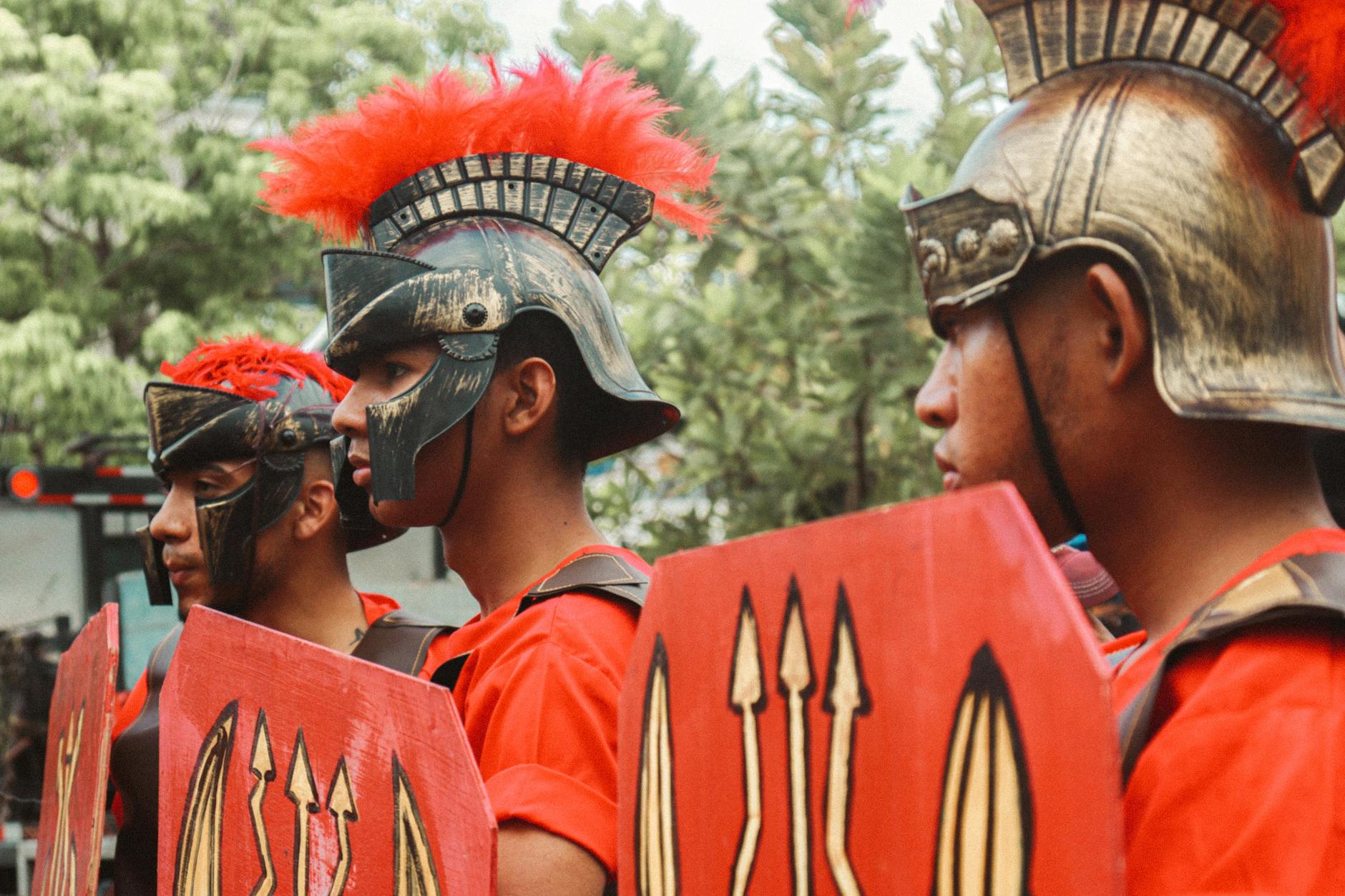
We know the story. The religious authorities joined forces with the political superpower of the day to end what they saw as an offense against piety and an assault on the established order – in other words, to terminate a threat to the status quo. They acted decisively to stamp out the menace. And when they were done, they had stamped him into the ground, into a hole in the ground; and they buried him there. As far as they were concerned, the fire of extremism had been snuffed out.
But the combined forces of religion and politics buried more than a man in that tomb. They buried his followers’ joy, their hope, and their future. When we see those followers again, they are filled with despair: Peter weeping in the night, the Eleven, trembling with fear, hidden behind locked doors. You can hear the despair in the voices of the two on the road to Emmaus when they said: “We thought” – but alas, we were mistaken – “that he was the one who would redeem Israel.”
These people had staked their lives on Jesus. They had left everything, as Peter declared, to follow him: jobs and families, homes and security. Now what were they to do? Would they have jobs to go back to? Would their families take them in? Would their company be disbanded? These men and women were closer than family. Would the future tear them apart, leave them only memories? And even those memories were being pushed from their minds. Right now, all they could think about was their Master being dragged away, nailed down, strung up, and crying, “My God, my God, why have you forsaken me?”
A handful of women went to the tomb early on Sunday morning. They left from different parts of the city, but intended to meet there to properly finish the Jewish burial procedure. But as they approached the tomb, one of them suddenly remembered the great stone that sealed the entrance. “Who will roll the stone away?” they asked. It seemed an insurmountable obstacle. But heaven had solved that problem even before they had begun to worry about it! (I wonder how often that happens to us.) They arrived to find the stone already rolled away. They may have thought that Joseph, who owned the tomb, or Nicodemus who accompanied him, were acting on the same idea and were already inside, completing the burial rites.
Or perhaps something more nefarious. The stone rolled away, the Roman troops missing, the body gone—it all pointed to one thing. The authorities must have removed the body as a final humiliation. One of the women, who arrived at the tomb before most of her friends, turned and ran to tell the apostles. That was Mary Magdalene. She was out of breath when she reached them. Peter and John ran to the tomb to see what had happened, and she followed them, but she could only walk, panting.
By the time she got back, the men had already left. She stood there, crying at this final indignity. They (whoever they were) had committed one last sacrilege; they had desecrated his tomb and taken his body. They were probably doing unthinkable things to it right now, after which they would throw it on the garbage dump in the Hinnom valley, which is what happened to most execution victims.
This was too much. Not having slept for days, overcome with emotion, and finding herself all alone, she breaks into tears. When a couple of men there ask her, “Woman, why are you crying?” she bawls, “They have taken my Lord away and I don’t know where they have put him.” Even now, she doesn’t grasp of what has happened.
We can hardly blame her. The world has turned upside down and inside out. The prophet once said, “Woe to those who call evil good and good evil, who put darkness for light and light for darkness, who put bitter for sweet and sweet for bitter.” But God had done just the opposite, had turned evil to good, put light for darkness, and transmuted unbearable bitterness into something unforgettably sweet.
Have you ever looked at something for a few seconds without really seeing it? Then suddenly it dawns on you what you are looking at? These people in the restaurant are your friends—this is a surprise party for your birthday! The face in the window isn’t your neighbor. It’s your oldest friend – you haven’t seen him in three years – and he’s laughing at you from the other side. Or this place … this is the town you stayed in thirty years ago, when you first got married. We’ve all had that experience, when things seen but not understood suddenly come into focus. For the Magdalene, everything came into focus at the sound of her name: Mary. Suddenly she knew the men to be angels, the Gardener to be her savior, and the Garden tomb a little bit of heaven.
Some of us have had a similar experience. We see the tomb with the stone tossed away. We believe the tidings of the apostles. And then God speaks our name. That’s when everything comes into focus. This, all of this, was also for you and me. The stone was not only rolled from the Garden tomb; it’s been rolled from our graves, as well.
In this retelling of the events of the first Easter, John the Apostle and Mary Magdalene narrate the story of the morning of Jesus’s resurrection from their own perspectives. Two of California Road Missionary Church’s resident actors, Cam Matteson and Janelle Rundquist, bring their stories to life. Watching this will give you a new appreciation for the biblical account of the resurrection!
There is a story in 2 Kings chapter 18 that reads like the Hollywood script of a twenty-first century political thriller. A country’s young leader is faced with a dreadful decision. His country must either submit to a ruthless foreign power’s unfair demands or go to war against an opponent whose military might dwarfs their own.
The young leader is Judah’s King Hezekiah, who reigned around the turn of the seventh century BCE. He was an excellent leader who won his people’s confidence in the early years of his reign. But after fourteen years on the throne, Assyria, the superpower of the day, demanded that Hezekiah and his people pay the Assyrians tribute. Hezekiah did not want to do this, but neither did he want to expose his country to a hopeless war. He paid the tribute.
But yielding to a bully only invites further bullying. It was not long before Assyria was back. This time the demand was nothing less than the dissolution of the nation. The king of Assyria sent his shrewdest envoys, backed by a large army, to Jerusalem to negotiate the dissolution of the Judean government and the transfer of national land and wealth to Assyria.
What follows is something like a chess game. The king refuses to speak to the diplomatic team from Assyria but sends representatives out to them. The Assyrian king’s underlings are not important enough to speak directly to Israel’s king. If they have something to say, let them say it to his subordinates.
But his subordinates are completely outmatched by the Assyrians. Their spokesman insists on holding talks before the public. This is not because they care about the public, but because they think they can leverage the public into pressuring the government to surrender. The Judean representatives ask that negotiations be conducted in Aramaic rather than Hebrew. They worry that Judah’s citizens will believe the malicious propaganda that is being spread. The Assyrians completely ignore them and continue speaking in Hebrew – perhaps more loudly than before.
The Assyrian representative publicly blames the conflict on Judah’s king by claiming that he has “rebelled” against Assyria. He then mocks Judah’s defense plans and berates her (potential) allies. He makes the idea of going to war against Assyria appear absolutely ridiculous. He even taunts Hezekiah with a wager: “My master will give you two thousand horses to help you in your war (though I doubt you can find two thousand horsemen to ride them), and, even so, his B-team will still destroy you!”
Because the Assyrians know that King Hezekiah is a pious, God-fearing man (and that many of Judah’s citizens are not), they mock his faith. “Oh, you are trusting in your God! That’s just what the people of Hamath and Arpad said, right before we wiped them out. That’s what Samaria claimed, before we conquered them and took their land.”
“Besides,” he taunts, “who do you think sent us to conquer you? It was the LORD himself, the God you worship. If you fight us, you are fighting Him.”
The Assyrian spokesman then addressed Judah’s people directly in their own language. (It would be like an English-speaking representative of the Chinese government purchasing air time from broadcast companies and streaming platforms to directly petition the American people to defy their president.) Using Hebrew, he warns the people not to put their trust in the LORD for deliverance. “That’s the kind of thing all our enemies think—right before we destroy them.”
This story, with its high stakes, devious tactics, and diplomatic intrigues shines a bright light on James 1:2-3, which states: “Consider it pure joy, my brothers, whenever you face trials of many kinds, because you know that the testing of your faith develops perseverance.”
James understood that our trials are a test of faith. This is so hard for us to remember. When we face a difficult trial – think of Hezekiah and the people of ancient Judah – we assume that our courage is being tested, or our intelligence, or our strength. Perhaps they are, but the primary test is always of our faith. Will we trust God or not? In the course of any trial, we may be tempted to doubt God’s intentions (2 Kings 18:25) or power (18:33-35); question our fitness (18:23-24); worry about our past actions (18:22); fear for our future (18:27); and make compromises for our comfort (18:31).
But it all boils down to one thing: will we trust God or not? We think it is more complicated than that. But once we know what the right thing to do is (which can be very difficult to determine), the only question left is whether we will trust God and do it. It is our faith, as James clearly states, that is being tested.
It helps to know what we are being tested on. If I have a major exam in my History of Western Civilization class, it will help me prepare if I know what the subject of the test is: is it on Greek supremacy from the time of Alexander through the Carthaginian War, or the Western response to Hitler’s expansion in pre-World War Two Europe, or the rise of nationalism in western nations in the first quarter of the 21st century? I’d better know what I’m being tested on.
We do know what we are being tested on when trials come our way: our faith in God. The test is not meant to fail us but to show us where we are and help us get to where we want to go.
How do we get better at faith? We start by doing what we know God wants us to do. We don’t need to go off to a monastery or enroll in seminary (unless that is what obedience to God requires). There are things for us to do right where we are: invite the neighbor we don’t know well to dinner or to church; love a fellow church member by a word of encouragement (or even rebuke); speak well of a former friend who speaks evil of us (blessing those who curse us); fast for a day and pray—or a thousand other things perfectly suited to our lives. Every act of obedience exercises, and so strengthens, faith.
In the final tests of faith, death and judgment, it is those who have exercised faith (Paul refers to this as “the obedience of faith”) who pass the test.
There was much more going on at Jesus’s “Triumphal Entry” than most of us realize. This sermon examines the various groups that were present and the motivations behind their actions. It also shows why Jesus’s entry in Jerusalem on that first Palm Sunday is relevant to us in the 21st century.
Watch
Viewing Time: 25:26
Loading…
Read
Today is Palm Sunday, when the church celebrates what is known as “The Triumphal Entry.” It was Jesus’s highly symbolic entrance into the Capitol City just days before he was betrayed and executed. Most of us know the broad outlines of the story. Jesus rode into Jerusalem amid the cheers of a welcoming crowd. Five days later, those same people shouted for his execution. The fickle crowd turned against Jesus and had him crucified.
But that is not the entire story. It is not even the same story. For us to understand what is going on as Jesus rides into Jerusalem, we need to know who the different groups are that were involved and how each looked at what was happening.
The first group is comprised of Jesus and his disciples, though we should probably distinguish between them, since Jesus and the disciples understood what was happening in very different ways. The disciples were – this is the Evangelist Mark’s description – “astonished.” Jesus, who had always skirted the “messiah” question – warning his apostles not to talk about it, ordering the demonized to be silent – was now leading a massive crowd of pilgrims into the city, like a general marshaling his troops. Jesus had taken charge.
I suspect the disciples thought: “Finally! We’ve been waiting for this for three years! This is the beginning of the revolution. Jesus is taking his rightful place at last.”
When the crowds acknowledged Jesus to be the coming one – that’s shorthand for Israel’s messiah and the king, and he didn’t silence them; when the Pharisees begged him to tell the crowds to be quiet, and he refused, replying that if they were quiet the very stones would cry out – that’s when the disciples knew it was really happening. I think they must have been frightened, invigorated, and deliriously happy all at the same time.
The next groups are the crowds, and I say “groups” intentionally because there is more than one and we won’t understand what is going on unless we distinguish between them. The crowds that hailed Jesus as Messiah and king comprised one group. For the most part, they were pilgrims who had traveled to Jerusalem from Galilee for the Feast of Passover. That group included some of the same people who, a year earlier, tried to force the kingship on Jesus. (You can ready about that in John 6.) They want change and they believe Jesus is one to bring it.
But Galileans don’t comprise the entire crowd. There are thousands from around Judea and from Jerusalem. Many of these people know about Jesus and some have heard him teach, but they have had far less face time with Jesus than the Galileans. And there are still others from Jewish communities in Syria, Egypt, and around the Mediterranean, most of whom have never heard of Jesus. It is primarily the Galileans who chant Psalm 118:26, “Blessed is he who comes in the name of the Lord.” Others in the crowd doesn’t know what to think.
So, it wasn’t the people hailing Jesus as king who turned against him five days later. They probably didn’t know about his crucifixion until it was already happening. The people who shouted for Jesus to be crucified were Judeans who only knew what their leaders – Jesus’s enemies – told them.
Those leaders comprise yet another group. They have been opposed to Jesus for a couple of years, and since the Feast of Tabernacles, which was six months earlier, they have been working on plans to get rid of him. As they watch him entering the city, they do not see the arrival of their new national leader, like the Galileans; they do not see a Messiah, like the disciples. They see a volatile firebrand who is about to bring the iron fist of Rome down on them. They’re scared. At a recent meeting of the nation’s highest ruling body, members were saying: “What are we accomplishing? …If we let him go on like this, everyone will believe in him…” (John 11:47).
The raising of Lazarus from the dead had sent the nation’s leaders into a tailspin. It had happened a few months earlier, and the religious leaders had been beside themselves ever since. All their efforts to stop Jesus had failed, and now he had performed an outstanding miracle right in their own backyard. They were desperate to get rid of him. “If we let him go on like this,” they had concluded, “… the Romans will come and take away both our place and our nation” (John 11:48).
The other group present werethe Romans – the Roman army, to be precise. Each year at Passover, the Roman prefect deployed troops to Jerusalem to keep the peace. Passover was the Jews’ Independence Day, and at Passover nationalist fervor ran high. There had been much civil unrest at past festivals, even violent insurrections. So, now, at Passover time, you can’t look left or right without seeing a Roman soldier. They’re everywhere.
So, why didn’t the soldiers see what was going on? Or if they did, why didn’t they stop it? That presents such a problem to some scholars that they have claimed the church made up the triumphal entry. They insist that if anything like what John describes had really take place, the Roman military would have intervened.
But they are mistaken. They forget that the Roman army was comprised of men from all around the Mediterranean. There were Egyptians, Syrians, Greeks, Italians, Asians, Cappadocians, Libyans, and many others. But there were no Jews. Jews didn’t serve in the Roman army. That means that there were few, if any, military personnel who understood what the crowds were yelling in Aramaic. They would have heard the noise and the cheers, but they would not have seen that as a threat.
Neither would the Roman soldiers have grasped the symbolism in Jesus’s choice of a donkey’s colt for a mount. Romans – especially Roman soldiers – knew all about “triumphal entries.” Whenever Caesar or one of his generals returned victorious from a battle in which at least 5,000 enemy combatants had been killed, a great celebration – a triumphal entry – took place. Jesus’s entry into Jerusalem didn’t look anything like that.
When Caesar returned from battle, tens of thousands lined the road into Rome. They cheered as he rode by in a chariot, pulled by great steeds. Behind him was a long line of captives, including kings and generals. The procession would wind its way to the arena, where thousands gathered to watch selected captives fight wild animals.
Is it any wonder the Roman soldiers missed the triumph of Jesus’s triumphal entry. They did not see a mighty warrior. They saw a man in commoner’s clothing. There were no great steeds, only a young donkey. And where were the captive kings and generals? They saw peasants and children
Here is something to remember. What God sees as important and what people see as important are two different things. For the most part, the world is always excited about all the wrong things. If we follow their lead, we will miss the right things – we will miss what God is doing in the world. This is a big problem for many of us who confess Jesus Lord.
Now that we know the parties involved, we are ready to look at what is taking place. Look at verse 12: “The great crowd that had come for the feast…” (These are Galilean festivalgoers who arrived in Jerusalem before Jesus. The Jerusalemites hadn’t come for the feast; they were already there.) “…heard that Jesus was on his way to Jerusalem. They took palm branches and went out to meet him…”
But palm trees don’t grow around Jerusalem, which is another reason historians doubt the validity of the Triumphal Entry. They do, however, grow in Jericho, and thousands of Galileans had just passed through Jericho on their way to the festival. Jesus himself had come through Jericho at the head of a caravan just days before. The fact that they had cut palm branches and brought them with them suggests they had this in mind before they got to Jerusalem. This was, I think, a second attempt on the part of Galileans to force Jesus to declare himself Israel’s king. And this time, Jesus did not stop them.
Alongside the Galileans is a sub-group of the Jerusalemites. There are the people who were present when Jesus raised Lazarus from the dead, and the friends whom they had told about it. They also came out to meet Jesus. This is verse 17: “Now the crowd that was with him when he called Lazarus from the tomb and raised him from the dead continued to spread the word. Many people, because they had heard that he had given this miraculous sign, went out to meet him.”
As Jesus rode by, people in the crowd (these are probably the Galileans) began shouting, “Hosanna,” which is Hebrew and means something like, “O save!” I say, “something like” because by the first century the word was used as a general shout of praise or celebration. If you’d asked the people shouting it to define it, they might have struggled. It was like our word, “Hooray!” We all know what it means but not many of us could define it.
They also cried, “Blessed is he who comes in the name of the Lord! Blessed is the King of Israel!” (John 12:13). If the Roman soldiers had understood Aramaic, there would have been problems right then and there. They didn’t; but the Pharisees and scribes did. The crowd was shouting to Jesus the words of Psalm 118, which was sung every year at Passover.
“The one who comes” or, literally, “the coming one” was a title for the Messiah. These people were hailing Jesus as Israel’s savior and king. Some of the Pharisees begged Jesus to stop people from chanting this. But this time, for the first time, Jesus welcomed it.
Look at verses 14 and 15: “Jesus found a young donkey and sat upon it. As it is written, ‘Do not be afraid, O Daughter of Zion; see, your king is coming, seated on a donkey’s colt.’ At first his disciples did not understand all this. Only after Jesus was glorified did they realize that these things had been written about him and that they had done these things to him.”
Why a donkey’s colt? If Jesus wanted to make an impression, wouldn’t he have done better to borrow a horse—maybe even a chariot? Peddlers rode donkeys, not kings. But Jesus knew something that the Roman soldiers didn’t know and that the disciples momentarily forgot: in the Old Testament, Zechariah had prophesied that Israel’s king would ride into Jerusalem on a donkey’s colt.
Jesus was intentionally fulfilling Zechariah’s prophecy: “See, your king is coming, seated on a donkey’s colt” – in other words, coming in peace. But the disciples, even the ones Jesus sent to get the colt, didn’t realize at the time that Zechariah was writing about Jesus. They were caught up in a great big story, playing a role in it, and didn’t even know it.
I think that happens to us too. Whenever we do what Jesus says, we get caught up in his story and become a part of it, even when we don’t realize it.
When Jesus’s adversaries heard the shouts, saw the palm branches waving, and cloaks being laid on the road in front of Jesus (which was what people had done at the coronation of King Jehu), they were confounded. Look at verse 19. “So, the Pharisees said to one another, ‘See, this is getting us nowhere. Look how the whole world has gone after him.’”
The Pharisees and their fellow-conspirators had decided not to arrest Jesus during the feast, for fear of inciting a riot. Now, they were having second thoughts. Could they afford to wait? The whole city could be a bloodbath by week’s end.
Blood was shed, as we know, but it was Jesus’s blood. The story of which he was a part – was the lead character – the story that had begun long before Zechariah’s prophecy, that went back to the foundations of the world, was coming to its climax. The Lamb of God was being offered – was offering himself – for the sins of the world.
This is the story that we are in, the story of the God who pursues us, the maker who restores us, the Father who comes running to meet us. It is a love story, an adventure story, and a divine comedy all rolled into one. And everything turns out all right for those who belong to Jesus.
But from inside the story, things often look like they will turn out all wrong, which is why “we live by faith, not by sight.” After a tornado swept through a small town, a local builder had more work than he could handle. His own home had been destroyed and he and his wife were living in a one-bedroom apartment while he worked on everyone else’s homes. He worked hard and was fair to everyone, with the possible exception of himself and his wife.
His final post-tornado build was for a businessman who owned properties all around the area and for whom he already had done a great deal of work. This was not a repair; it was a demolition and new construction. The businessman visited the worksite weekly, and sometimes several times a week, to make sure everything was being done to his satisfaction. The builder just wanted to get this one done, so he could finally start work on his own place, but he was conscientious and he did his work well.
When the house was finished, the businessman was there to receive the keys. He said to the builder, “Look, I know I’ve been tough on you. You have been working hard and I pushed you even harder … but I wanted this house to be just right because I was having it built for a special person.” Then he handed the keys back to the builder and said, “These are yours. You didn’t know it, but all this time you’ve been building this house for yourself and for your wife.”
As we go through life, doing our work, struggling over hardships, helping others for Christ’s sake, we don’t realize that God is using these things to build us. We won’t fully realize that until we stand before the Lord in glory.
“At first his disciples did not understand all this. Only when Jesus was glorified did they realize that these things had been written about him and that they had done these things to him.” I suspect that when we get to heaven, we shall have this same experience repeatedly.
Things we didn’t understand, that made no sense to us at all, will light up with meaning. We will see God’s hand everywhere, bringing good, righting wrong, redeeming the time. Sometimes we will see that his hand was operating – to our joy and amazement – through us. Sometimes – to our shame – that his hand was operating despite us. But, at all times, he was doing what was right and good.
The key to making sense of our past – and our present, for that matter – is found in the words, “only when Jesus was glorified…” When Jesus is glorified, the light that comes from him makes things clear. But in isolation from Jesus and his glory, our circumstances are a book written in a language we can’t understand.
We don’t have to wait for the new age to glorify Jesus. Our lives can be all for his glory now. When they are, things we’ve never understood will shine with meaning. But we see this only in the light of Jesus’s glory.
One of the books I most enjoyed reading is J. R. R. Tolkien’s Lord of the Rings. Professor Tolkien’s character, Aragorn, reminds me of Jesus. Though many people criticize him and some hate him outright – and almost no one understands him – he labors for their good in relative obscurity. Only a handful of people know who he really is: their rightful king.
Then the day comes when he enters into the great city and reveals his true identity. A herald proclaims: “Here is Aragorn son of Arathorn, chieftain of the Dunedain of Arnor, Captain of the Host of the West, bearer of the Star of the North, wielder of the Sword Reforged, victorious in battle, whose hands bring healing, the Elfstone, Elessar of the line of Valandil, Isildur’s son, Elendil’s son of Numenor.”[1]
Then the herald cries, “‘Shall he be king and enter into the City and dwell there?’ And all the people and all the host cried ‘Yea!’ in one voice.”
This scene has a parallel in real life. Every time a person acknowledges Jesus as Lord and welcomes him into his or her life, there is a triumphal entry. And those who welcome him now will be welcomed by him then, when the King returns. He will say, “Come, you blessed of my Father, enter into the joy of your Lord!”
Today, I serve as herald to the King of Glory. “Here is Jesus the Messiah, the Second Adam, the Bright and Morning Star, the First and the Last, Son of David, Son of Man, Lamb slain before the foundation of the world, Fear of Jacob, Lion of Judah, Wonderful Counselor, Mighty God, Everlasting Father, the Prince of Peace.”
Shall he be king and enter your life and dwell there? What say you: Yea or Nay?
Loading…
[1] Ken Langley, Zion, Illinois, in Preaching Today.com
Biologically speaking, before you became who you are, you were a zygote—a single fertilized cell with mind-bending potential. Soon afterwards – within a matter of hours – you were a morula (Latin for “mulberry”). A morula is comprised of 60 or more cells, all lumped together. At this point in your biological development, you looked like a microscopic mulberry. Your biological potential, originally housed in the DNA of parental gametes, was still unthinkably vast, yet slightly reduced.
By about five days into your biological journey, you became a blastocyst. At this point, you were comprised of something like 150 cells. At each stage of development, you became bigger and better defined, but always at the cost of potentiality. You started with the potential to be anyone within the confines of the DNA in your cell. Since there are 3.2 billion nucleotide pairs on our chromosomes (humans have 46 of them), and every one of those pairs can combine in four possible ways, that is a lot of potential. By day 5, the billions of different versions of you that had been possible had decreased. You were on your way to becoming yourself.
You were an embryo before you knew it—quite literally. Significant development occurred during the embryonic phase, which means that your potential (though still vast) has been further narrowed. Nine weeks in and you are a fetus. You’re beginning to look like a human being and even like a particular human being, but advances in development always comes at the cost of diminishing potential.
By the time you were born, your biological potential (for example, the color of your eyes, the shape of your face, the complexion of your skin, your body type) was narrower than it was when you were a morula. With each step of development, the breadth of potentiality is diminished. In return for this expenditure of potential, you became more substantially (and not just potentially) yourself.
I am now a 67-year-old man. My potential as a biological creature has been significantly reduced from when I was a child. I have paid (and continue to pay) the piper of potentiality. What I have received for that payment has been me—not a potential me, but the real-deal, existential me.
I hope I’ve been worth the price.
But even though I am past middle age, I am still becoming. This seems a hugely important fact about me and about all humans. It’s true that my potential has been diminished by the volitional choices I have initiated and the biological changes I cannot stop, but it has not been exhausted. I have become a particular me rather than many possible versions of me, but the particular me is not yet fixed. I can still change, grow, and become. The potential to become something I am not now is at the heart of what it means to be human.
(What I’ve written in the paragraph above is not meant to convey the idea that I am who I am solely on the basis of my own choices. My choices are an important factor in my development, but hardly the only one. They are, however, the one for which I am responsible.)
Humans never stop changing. Still, an older person, say someone my age, might say: “Of course, I changed when I was younger, but not anymore. I settled into who I was going to become a long time ago.”
Nonsense. People continue to change, regardless of their age. Their bodies change whether or not they want them to. Brains grow and atrophy. Muscle mass increases for a time, then begins to decrease. Our bodies replace billions of cells every day. We are always developing into something different than what we are now.
Change on the biological level is not the only kind of change humans experience, nor is it the most important. Humans are a biological/spiritual hybrid, and transformation happens across both areas. Man (in the generic, Genesis 1:27 sense, comprised of both male and female) is becoming something that he/she is not now, but whether that something is godlike or devilish depends on the individual.
That is what C. S. Lewis had in mind when he said: “It is a serious thing to live in a society of possible gods and goddesses, to remember that the dullest and most uninteresting person you talk to may one day be a creature which, if you saw it now, you would be strongly tempted to worship, or else a horror and a corruption such as you now meet, if at all, only in a nightmare. All day long we are, in some degree, helping each other to one or other of these destinations.”
A serious thing indeed. I am progressing toward an end in which I will be joyful and joy-inspiring or wretched and revolting. That I will be one or the other is certain. Which I become depends on my attitude (in the sense used by pilots) toward God—my orientation in reference to him. If I am moving toward him, I am moving toward godlike joy. If I am moving away from him, I am headed toward wretchedness and ruin.
This is why Lewis claimed: “There are no ordinary people. You have never talked to a mere mortal. Nations, cultures, arts, civilization—these are mortal, and their life is to ours as the life of a gnat. But it is immortals whom we joke with, work with, marry, snub, and exploit—immortal horrors or everlasting splendours.”
I will still be in process of becoming when I die. It is the resurrection that will seal who I will become, though the process of growth and change may (and, I think, will) continue. To be human is to change. God sent his Son so that the change might be into eternal joy and not unending wretchedness.
When he looks at me, I hope he thinks the price was worth it.
Nearly everyone who knows anything about the Gospels would say that Peter was the leader of the apostolic band. There is good reason for saying so. His nickname (Peter) appears 156 times in the New Testament and his given name (Simon) dozens of additional times. Peter was the first of the apostles to declare that Jesus was Israel’s Messiah. Jesus spent more time with Peter than he did with most of the other disciples, and gave him more tasks to do than he gave the others. In lists of the apostles, Peter’s name always comes first, which was an important indicator of rank in ancient literature.
Peter certainly seems to have been the leader of the apostles and yet there was a time when his leadership seems to have been in question. Witness the arguments among the disciples, which happened on more than one occasion (Mark 9:34; Luke 9:46; 22:24) about which of them was the greatest. Peter’s supremacy was apparently not taken for granted by the other apostles. They even argued about it on the eve of Jesus’s crucifixion!
Very interestingly, Peter disappears from each of the four Gospels for a period of time before the triumphal entry. (I first learned of this from Leon Morris’s great commentary on John.) For example, Peter is not mentioned between chapters 19 and 26 of Matthew. It was during this time that James and John, the sons of Zebedee, went secretly to Jesus to request the highest positions in his organization. That was probably not a coincidence.
In Luke, the absence occurs between chapters 18-22, which covers the same time span as the gaps in Matthew and in the more condensed narrative of Mark. In John’s Gospel, the gap occurs between chapters 7 and 13. Peter is conspicuously absent at the raising of Lazarus. This is particularly apparent when Thomas steps up as spokesman for the apostles (John 11:16).
That Peter is not mentioned is successive chapters of the Gospels is not sufficient evidence to prove his absence from the apostolic band, but the fact that these reference gaps occur during the same time period across all four Gospels is very persuasive. So, let us assume that Peter had to leave the apostolic band for a space of time – a few weeks to a couple of months. Let us assume that family issues forced his temporary departure. (He was, after all, married, and his mother-in-law had been seriously ill at an earlier time in the Gospel record.)
We can imagine that Peter might have been a little uncertain of his position of leadership when he returned to the apostles. What may have made things worse – may have caused Peter considerable anxiety – was the seating arrangement at the Passover meal on the night of Jesus’s betrayal. If Leon Morris was right (and I expect he was), Peter was not seated on Jesus’s immediate right or left—the highest places of honor. This seems to be the case, since we know that the unnamed disciple (probably John) was sitting next to Jesus when Peter signaled him to ask Jesus which of the disciples would betray him. Seating arrangements were carefully planned in first century Israel, and if Jesus had Peter seated well away from himself, both Peter and the other disciples may have interpreted that as a demotion.
Peter’s return to the apostolic band, which seems to have happened not long before the Triumphal Entry, may have led to the crucifixion eve argument over which of the apostles was greatest. Peter himself was likely uncertain about where he fit—and worried about it. This might explain why he stubbornly told Jesus, who had washed the feet of one disciple after another, that he would never wash his feet. It may also lie behind Peter’s vehement contradiction of his master when Jesus predicted that all the apostles would forsake him. Peter, remember, said: “Even if all fall away” – that is, all these other guys – “I will not.”
It may also explain why Peter, who carried a short sword, followed Jesus all the way to the house of Annas, the former high priest who still called the shots in Israel’s politics. Did Peter think that liberating Jesus from the enemy would prove his worth?
One can imagine Peter thinking to himself: “Which of us is the greatest? That’s easy. The one who risks his life. The one who frees his Lord or dies trying. He’s the greatest.”
Of course, Peter didn’t die trying. But something in him did die that night: his self-confidence, self-importance, and misplaced sense of honor. Three days later, they were resurrected and transformed into confidence in God, the importance of friends, and honor for his Lord.
Elijah the Tishbite was arguably the greatest of the Old Testament’s prophets. The man was extraordinarily brave, keenly discerning, and profoundly spiritual. He was guided by God in remarkable ways. His actions turned an entire nation from idols to God in a single day.
It is easy to think that there is a great divide between Elijah and people like us. Some preachers actually encourage this kind of thinking. I had a book on my shelves by a late 19th century author that lionized Elijah. He wrote: “Elijah towers up like a mountain…above all the other prophets. There is a mystery and un-earthiness about Elijah. As Elijah never died, so he was never born, as we are born. Elijah came from God and he went to God. Elijah stood before God till God could dispense with and spare Elijah out of his presence no more.”
So, Elijah is a towering mountain and the rest of us are the merest molehills? Yet James wrote “Elijah was a man with a nature like ours” (James 5:17, ESV). He had feelings, cares, worries, just like we do. He struggled with doubts. He shared our strengths, but also our weaknesses and foibles.
In 1 King 19:3, we read: “Elijah was afraid and ran for his life.” A more literal translation runs, “Elijah saw and ran for his life.” What was it that Elijah saw, and just how did he see it?
Elijah saw that Queen Jezebel had ordered his assassination. He saw that she had the power to pull it off. He saw that there would be no place in Israel where he could hide. He saw that with him out of the way, the nascent revival that had just begun would die out. He saw that all his sacrifice – years of being on the run, eating scraps, sleeping in caves – would all be for nothing. What he saw left no room for hope.
That is what he saw. But how did he see it? He saw it with his mind’s eye. His imagination could picture it unfolding. And though he did not see all this with physical eyes, it was as real to Elijah as if he had.
When we believe something to be true – whether it is hardly matters – our emotions will respond as if it were true. That is what happened to Elijah. He saw unmitigated disaster, panicked, and lost hope. He became seriously depressed, even to the point of wanting to die.
But what Elijah saw with his mind’s eye was misleading, for it was missing something. It saw, truly enough, Jezebel’s ferocity and Israel’s lack of resolution. It saw days of hardship. But it did not see God.
I, too, have “seen” things with my mind’s eye. I have seen how this person treated me in an unjust manner and why they did so. (It is remarkable how easy it is for the mind’s eye to detect motives!) I have seen how this person’s unexpected absence meant that they were leaving our group. I have seen how the event we are sponsoring will be a success and how that will result in increased momentum, positive morale, and the eventual attainment of our goal. I have seen all this—even when it wasn’t there.
The vision in my mind’s eye is suspect—or at least it should be. On some days this kind of vision is profoundly myopic, on other days it is ridiculously hyperopic, and on almost all days it suffers from a severe astigmatism. Sometimes my mind’s eye sees images that are bright and sometimes dark, but those images are almost always distorted. Nevertheless, I often assume that what my mind’s eye saw was real and accurate, and so my emotions respond accordingly.
Someone might think, and some people have certainly taught, that seeing positive outcomes with the mind’s eye is the essence of faith. But faith is not seeing the outcome we want but seeing the God we serve. Faith sees him who is invisible to the outward eye but perceptible to the eyes of the heart, and it sees him when circumstances are favorable and when they are ruinous, when life is so hard we don’t know how we can survive, and when life is so good we think we must have died and gone to heaven.
The cure – the corrective surgery – for the mind’s eye is an encounter with God. When Elijah understood that God was listening and when he heard God speaking, his vision finally cleared, his depression lifted, and his hope was restored. God supplied the corrective lens for his mind’s eye (see 1 Kings 19:14-18).
God is able to do the same thing for us when our vision is skewed. The trouble is we won’t know when our vision is skewed. That’s why we must learn to recognize hopelessness as a symptom of “Mind’s Eye Disease.” When the vision in our mind’s eye darkens and we start losing hope, we need to go to the One who knows how to “open the eyes of the blind.”
When people have talked about having an MRI, I have sometimes joked that “they” would need to hit me over the head to get me into an MRI machine.
A couple of weeks ago, I got hit over the head. I was at a breakfast meeting when the vision in the lower half of my right eye went dark. I felt odd. It passed in a minute or so (probably less), but I had lost my appetite and was ready to go home.
I had a doctor’s appointment already scheduled for that afternoon with a brand-new PCP, so I told him about my experience. His mind went immediately to a stroke, and he asked me a series of questions.
“Did you experience weakness?”
“No.”
“Did you experience confusion?”
“No.”
‘Was your speech slurred?”
“No.”
Based on that exchange, he referred me to an ophthalmologist … and scheduled an MRI.
For the past fifteen years, I have been seriously claustrophobic.
When I was younger, I had no fear of being enclosed in small places. I rather liked it. So, I don’t know what happened to change that, but it changed. The first time I experienced it I was on an airplane that had already landed and stopped at the gate. People got up – I wasn’t in the aisle seat, so I stayed where I was – but no one moved for about twenty minutes. I don’t know why they didn’t open the door, but I began to breathe hard. I looked for a way out. I wondered how many people I would need to knock over to get to the door. (I was near the back of the plane). I was having a panic attack, though I didn’t know it.
A few years ago, I had another panic attack. I was in the back of a 15-passenger van in Tijuana, Mexico. I took the back seat to be polite, to let other people have the nicer spots. But then 17 people clambered aboard. When the driver parked and got out (“I’ll just be a minute”) and didn’t come back for fifteen minutes, I had another panic attack. I quoted Bible verses for most of those fifteen minutes, while a voice in the background of my mind kept saying, “You’ve got to get out of here.”
And today, I have an MRI on my brain. Which not only means getting stuck in the tube, but being locked in a helmet. I’ve always heard that bravery is not the absence of fear but doing what needs to be done even when you are afraid. Today, I’ll find out how brave I am.
I’ve declined taking a pill to calm me. I have other things going on today and cannot afford to be loopy. I intend to pray in the MRI machine, quote verses, and praise God.
I’d almost forgotten: the test is happening because something is wrong in me. I suppose that is the serious thing, but I’ll think about that later. For now, “Each day has enough trouble of its own.”
This message from 1 Peter reveals three reasons Christians need to prepare. The video is just over 26 minutes. If you prefer to read the sermon, click here.
Leave a comment