
Driving around Chicago felt like a cinch after the crazy drivers and screaming racing bikes on the 405 in L.A. It felt like a cinch, that is, until the SUV immediately in front of us swerved one way, then the other, and then rolled over repeatedly.
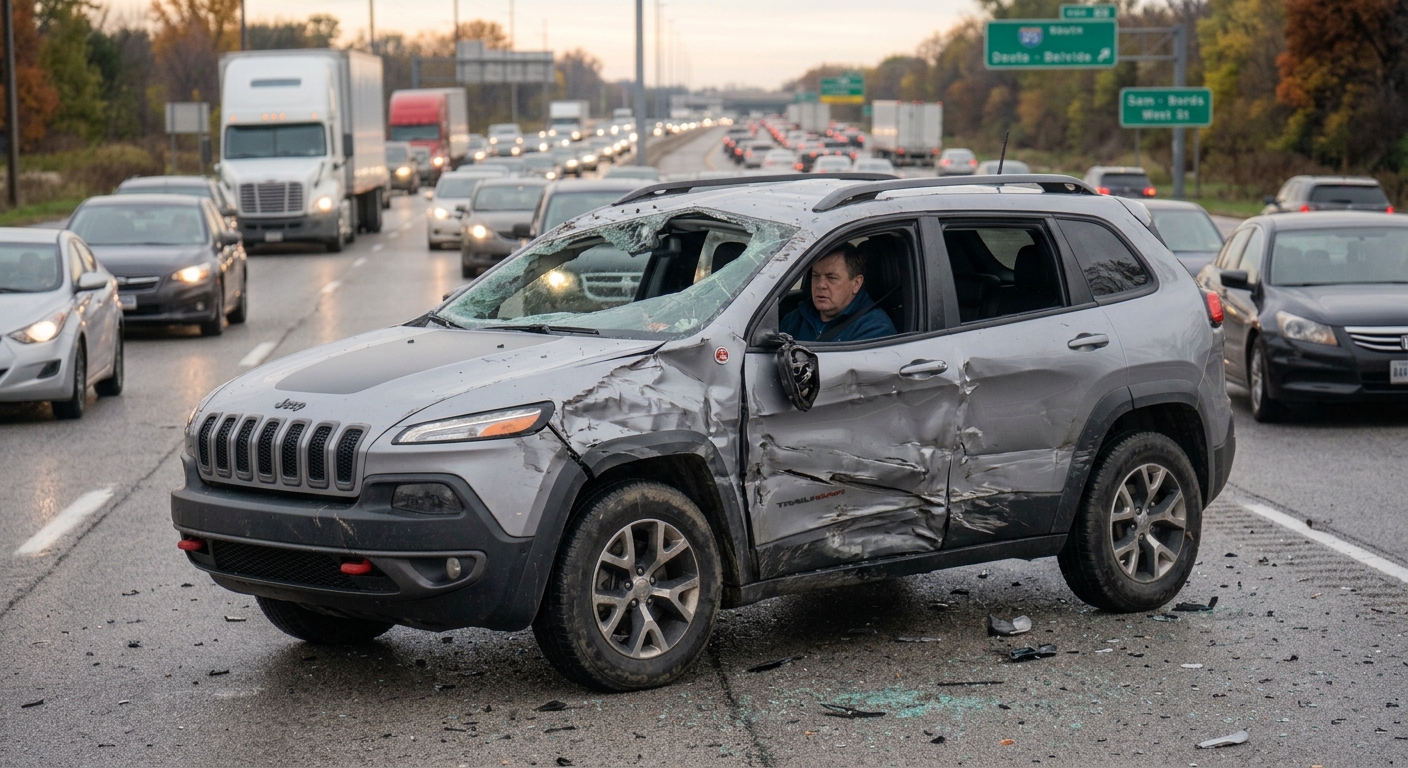
Had I performed the same maneuver in our sedan, our car would have kept its wheels. That’s because we have a much lower center of gravity. The SUV’s high center of gravity caused the weight load on the side wheels to shift dramatically, hence the rollover.
The term “center of gravity” refers to the point at which the entire weight of a body can be equally balanced. In racing, the center of gravity is enormously important. Two cars with equal power will perform very differently, depending on the location of their center of gravity. Establishing the center of gravity is consequential for mechanical engineering, athletics, dance and a whole host of disciplines.
Imagine a car that has been involved in a collision. It is still drivable, but the center of gravity has shifted from a spot under the firewall and midway between the doors to a place directly under the passenger seat. Now when the car turns right, weight is unevenly distributed to that side while the left tires lose traction. Because the center of gravity has been moved toward the rear of the car, acceleration is sluggish. Mileage drops precipitously. Braking is slow and uneven. The car has lost its center. It is an accident waiting to happen.
This can serve as a metaphor for understanding the human race, which always seems to be an accident waiting to happen. (Just in my lifetime, humanity has faced nuclear obliteration, a global network of terror, and the epistemic crisis and transhuman nightmares associated with the rise of AI—not to mention that we somehow survived disco and 80s music.) Thinkers in the Judeo-Christian tradition believe that humanity has been in a kind of collision. They refer to it as “the fall,” and believe that it has effectively moved our center of gravity. Humanity has lost its center.
This explains our sluggishness to respond to injustice. It explains why, when tempted to unethical or immoral behavior, humans find it hard to stop themselves. By the time we know it’s wrong, it’s too late to stop. It explains why we experience emotional roll-overs.
Before the fall, God was the gravitational center that kept humanity balanced. The collision (the fall) has moved that point away from God and toward the passenger side, where self-interest is located. Our lives are still drivable, but they handle so poorly that we can’t keep out of accidents: divorce, abuse, negligence, racism, unjust treatment of the poor, war, and the misuse of the earth, to name a few.
It takes major repair work to get the center of gravity back where it belongs. Politics cannot do it. Neither can education or social activism. Medical and psychological treatment are not equipped for it. These things are all good and helpful – even necessary – but they cannot, in and of themselves, provide a solution. That takes a power from outside us. The car that has been in a collision cannot fix itself. Neither can a person.
Only God has the know-how to fully restore a person damaged by “the fall.” He understands the intricacies of mind and soul, the interrelationships between them and between them and others. As the original designer, he knows how people are supposed to function. And as an experienced restorer, he knows what it takes to renovate damaged people.
It is conversion, renewal, and restoration that is needed. Conversion is a theological term for the change that takes place in a person when he or she trusts God and submits to his leadership over life. Conversion begins with an act of faith, but it doesn’t end there. It ends when one’s center of gravity has been restored to its rightful place, and that requires ongoing work.
Worship has a role in that work. Worship changes us precisely because it brings us back to our true center. In worship we both act and are acted upon; we give and receive. The push and pull of worship re-positions us, brings us into alignment with God, and works to restore us to our true center. Worship obliges us to “Acknowledge that the Lord is God! He made us and we belong to him; we are his people, the sheep of his pasture” (Ps. 100:3 CSB) To sincerely make that acknowledgment is to move toward our true center and our eventual restoration.
(This article has been revised from a 2015 article and was first published by Gatehouse Media, Inc.)


Leave a comment