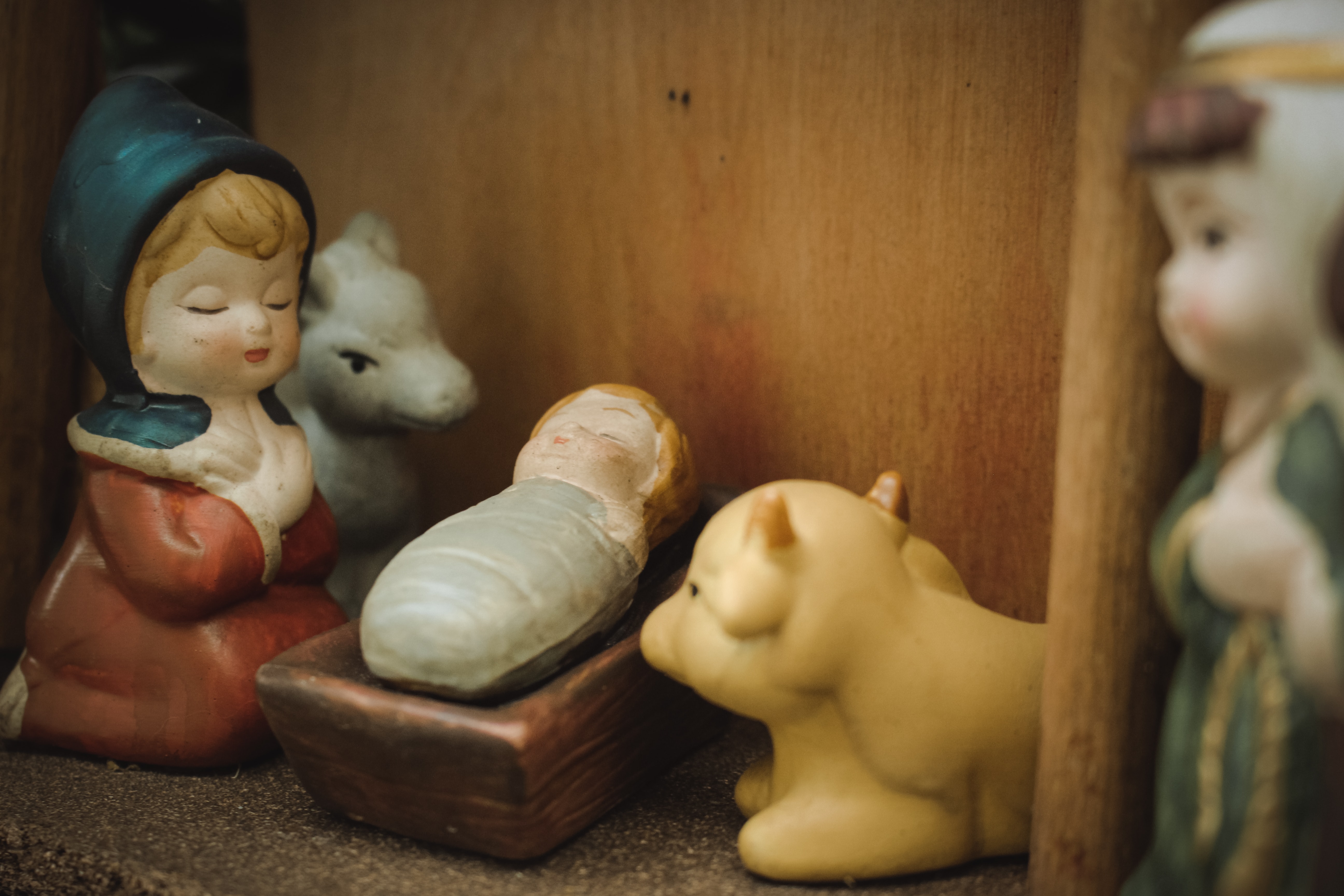
Finally, Some Good News: The Role of Witnesses in the Gospel

When people see something that interests or impresses them – whether a football game, a scenic vista, or people arguing at the supermarket – they talk about it. After Karen and I were married, we lived in a large apartment complex on our city’s southwest side. One morning around 2 or 3 o’clock, we heard a woman screaming for help out on the street. I jumped up, threw on some clothes, and went running out, telling Karen to call the police. (This was before we had 911.)

As I exited the building, I saw a car stopped in the middle of the street, with a woman on the far side of it – the woman who had screamed, I assumed. She was being pushed into the car by a man. As I ran, the car peeled off, and I never saw them again.

I was hardly a star witness. I couldn’t identify the woman. Was she tall? Short? I didn’t know. What was the man’s race? I wasn’t sure. What did the car look like? It was too dark to distinguish the color. I didn’t see the license plate. If I had been summoned to court, some defense attorney would have tied me in knots. They would have asked if I hadn’t dreamed the entire episode.

If I did, Karen dreamed it with me. I certainly didn’t see everything – the woman’s features or the car’s license plate – but I did see some things: a car in the middle of the street, a woman being pushed into it, the car peeling away as I approached. Karen and I both heard the scream for help.

Could I have misinterpreted what I saw? It’s possible. The girl could have been drunk and the person pushing her into it could have been her dad, taking her home to sleep it off. Or she could have been injured – that might account for the scream – and the car I saw could have been rushing her off to the hospital.

We are thinking about the role of witnesses in the gospel, beginning to pivot from what had happened to what the disciples did – and we might do – about it. Consider the role of witnesses in Paul’s bullet-point summary of the gospel:

1 Corinthians 15:3-8: “For what I received I passed on to you as of first importance: that Christ died for our sins according to the Scriptures, that he was buried, that he was raised on the third day according to the Scriptures, and that he appeared to Cephas, and then to the Twelve. After that, he appeared to more than five hundred of the brothers and sisters at the same time, most of whom are still living, though some have fallen asleep. Then he appeared to James, then to all the apostles, and last of all he appeared to me also, as to one abnormally born.

Could these witnesses have misinterpreted what they had seen? It’s possible but it seems unlikely. More than a dozen people in five different places at five different times saw Jesus on Day One. At one of those places, at least ten of them saw him simultaneously. Many (and possibly all) of those people saw him on subsequent occasions, some when they were alone and some when they were in groups. Some of the people who didn’t see him on Day One – Thomas, for example, did see him on Day 8 and then again later. Paul says that on one occasion more than 500 people saw him simultaneously and most of those people were still alive and could verify what he wrote.

Could these witnesses have been dreaming? Only if more than 500 of them had the same dream at the same time. Could they have hallucinated? I suppose anything is possible, but history reports no other hallucination on this scale – nothing even remotely like it.

Posted in Bible, Sermons, Theology | Tagged , , , | 1 Comment

Disruption: We Hate It but We Need It

Rather watch than read? Message begins at 22:36)

Disruption (n) – “the action of preventing something, especially a system, process, or event, from continuing as usual or as expected.”

This has been the year of disruption. Things have been disrupted at church: Services, classes, gatherings, funerals, even offerings. In our private lives, our routines have been disrupted. Karen and I have had to go into quarantine twice, in each case at a very inconvenient time.

It has been hard to get any momentum going this year. Just when things start to click, the virus surges again, a new set of Health and Human Services guidelines is issued, and a new round of business closures begins.

I can only imagine what it is like to be in school or to have a son or daughter who is in school at this time. Talk about disruption! The old routine is gone and what has replaced it can hardly be called routine at all. Classes have been held remotely, then in-person, then remotely again. Parents need to take personal time. Students need faster internet speeds.

The only thing more confusing than being a student or a parent during the pandemic is being a teacher or administrator – especially one with their own kids at home, trying to learn how to learn all over again.

We’re liable to think of our situation as unique, but the Bible is full of stories of men and women who found their routines turned upside down. Abraham’s life, for instance, was interrupted by God’s call to leave his home and family and travel to an unknown land. During the process, his brother died and he and his wife took in their nephew. Then his dad died. After that, he went through a major economic crisis and a war. Thinking about Abraham’s life sets my minor COVID-19 disruptions in an entirely different light.

Or what about Moses – forced to leave his wealthy home and support himself as an ag worker – a job he probably knew nothing about. Or David, whose once-grateful boss turned against him, forced the daughter to whom David was married to leave him, and did everything he could to ruin his life. Or Ezekiel, the refugee prophet whose wife died during a force deportation and he wasn’t even permitted to grieve.

Or consider Christmas. We are used to recalling the beautiful parts of the story of Jesus’s birth. But consider how disruptive it must have been to the lives of Mary and Joseph.  

(Luke 2:1-7) In those days Caesar Augustus issued a decree that a census should be taken of the entire Roman world. (This was the first census that took place while Quirinius was governor of Syria.) And everyone went to his own town to register. So Joseph also went up from the town of Nazareth in Galilee to Judea, to Bethlehem the town of David, because he belonged to the house and line of David. He went there to register with Mary, who was pledged to be married to him and was expecting a child. While they were there, the time came for the baby to be born, and she gave birth to her firstborn, a son. She wrapped him in cloths and placed him in a manger, because there was no room for them in the inn.

God, the theologians tell us, is omnipotent, immutable, and incomprehensible. They should have told us that he is also inconvenient. The eternal and omnipresent God doesn’t step into our little lives without disrupting our plans.  

Mary was probably a teenager when the angel appeared to tell her that she would conceive and have a son, the Son of God. No doubt Mary had other plans – getting married, for one (she was already engaged). Her fiancé was a great guy – she didn’t yet know how great a guy – but what man doesn’t leave when he discovers his fiancé is pregnant with someone else’s baby? Disruption.

Joseph was a stand-up kind of guy. He was the real deal. Righteous. Kind. A self-starter, who had what it takes to launch his own business. He too had plans, starting with getting married and having kids. Then he found out that his fiancé was already pregnant. Disruption.

One thing to know about disruptions is that they usually lead to more disruptions. After Joseph and Mary found out about the pregnancy, they didn’t just go on with their plans and their nice, quiet life. For reasons having to do with taxes and (quite possibly) scandalmongers, they decided to leave their hometown and move to Bethlehem, where Joseph’s family came from.

Moving is a disruption at any time. When we moved a few years ago, I considered it a major interruption – even though we only move two hundred yards to the east! Joseph and Mary didn’t move two hundred yards. They moved to a new town in a different province, almost on the spur of the moment. No job, no guarantees, and no moving van. They carried everything they had, either on themselves or on a donkey. We always picture pregnant Mary riding on a donkey, but most people didn’t have donkeys and the Bible doesn’t mentions one. Joseph may have had to carry their earthly belongings on his back to their new home.

But … what hew home? When they arrived in Bethlehem, they were homeless. It’s likely they ended up sleeping in one of the caves that dot the ridge that runs through the area. That is where the local shepherds “stabled” their sheep in inclement weather, and the earliest accounts of Jesus’s birth (after the Gospels themselves) assume that Jesus was born in a cave. When my wife was pregnant, she couldn’t get comfortable in our queen-sized bed. How did Mary manage a cave floor? Disruption.

After the baby was born, things slowly normalized. The couple found a house. Joseph must have found work, probably as a carpenter/builder. They were finally getting back into a routine. Then came the magi, who unwittingly brought danger to the young boy’s life, and their routine went out the window. For the second time in a couple of years, Joseph and Mary packed up their things on the spur of the moment and left, this time for a foreign country, where they again had to find housing and a job, among people who spoke another language. Disruption.

We may assume that such major disruptions happen to people like Joseph and Mary, but not to people like us. Yet, think about it: we are in the middle of a major global disruption – the pandemic. Much of the world is experiencing disruption. We are not exempt.

Everyone experiences disruption, even people who work hard to preclude disruption from their lives. In fact, those are the people who think of even minor inconveniences as major disruptions: the car won’t start – major disruption! Can’t go to the office because of quarantine – major disruption!  

The truth is that no one escapes disruptions. Lockwood has lost people during the pandemic, though only two of them (so far) from COVID-19. There are always disruptions, including cancer, stroke, heart disease, accidents. If you were rich enough to hide from the pandemic on your own private Caribbean Island, even that would be a disruption. But no one is rich enough to hide from death. We are all going to die someday and dying is the biggest disruption of all – terribly inconvenient!

The fact is most of us need a good disruption from time to time. We may not like it – probably won’t – but that doesn’t mean we don’t need it. Without occasional disruptions, the priority of our convenience, our plans, our schedule remain unchallenged, which can leave us assuming a false independence from God. God uses disruptions for our good, to teach us to trust him, to break us out of our self-centeredness and enable us to know him better.

He also uses disruptions to move us in new and better directions. The business world has a term for systemic changes brought about by the introduction of a new agent. They call it disruptive innovation. God has been managing disruptive innovation since he banished our first parents from the Garden. No one understands it better.

When God interrupts our lives: through something difficult, like sickness, joblessness, or the loss of a loved one; or through something positive, like a job offer, a move, a new relationship, we must be careful to keep our feelings in line with our faith. If the disruption is a bad thing, we are liable to catastrophize, to feel this thing is so terrible that we will never recover. If it is a good thing, we are liable to romanticize, to think that this will make life perfect. In either case, such feelings can cause us to lose sight of the Lord who is at work in both good times and bad.

When major disruptions come, there are things we can do that will help. We can remind ourselves and those with us that we are part of a larger story. There is a big picture we don’t see; but the author does. He is constantly connecting the arc of our storyline back to the main story, which is the greatest story ever. We won’t always see it; in fact, we only get glimpses of it. But we can always believe it if we know the God who gave his only begotten Son.

Even during disruptions, we can trust God’s purpose if we know his character. But trust is a choice. We don’t drift into it. We choose it. That is what as Mary did when, in the face of disruption and uncertainty, she said: “I am the Lord’s servant. May it be to me as you have said” (Luke 2:38). She chose to trust. We must do the same. We never outgrow the need to do this.

To trust God as Mary and Joseph did, we will need to submit our plans to him, knowing that he may take them off the table. As long as we insist on having things our own way, which is to say, as long as we make an idol of our plans, we won’t be able to trust God. It will simply be impossible.

Instead of trusting our plans, we can entrust our plans to God. If he takes them off the table, we’ll know it is to make room for something better. He took Joseph’s and Mary’s pleasant domestic plans off the table, but only to make room for them in the story of the salvation of the world. We can trust God – this God; the God who took our flesh and bore our sins – with the future, even when our plans have been disrupted, as they have this year.

Disruption does not have the last word. God does. Whatever the media may say, 2020 has not been the Year of COVID-19. It has been the Year of our Lord, as 2021 will be. COVID is not king. Jesus is.

Posted in Christmas, Faith, Spiritual life, Theology | Tagged , , | Leave a comment

Jesus Is Not Peter Pan: Let’s Stop Confusing Them

Public Domain,

I think we get Jesus confused with Peter Pan. We seem to think he is the boy who would not grow up.

A seven-year-old girl went with her grandparents to look at Christmas displays in the suburb where they lived. When they saw a large Nativity scene, Grandma called attention to it: “Look, Sarah, isn’t it beautiful?” And Sarah, who was a very smart girl, said: “Grandma, one thing bothers me. Jesus is the same size he was last year. Why doesn’t he ever grow up?”

Perhaps Jesus does not grow up because we won’t let him. We love the baby Jesus. He is so sweet, sitting on his mother’s lap, like he is in Leonardo’s painting, stretching out a tiny hand to his admirers. It is all so charming – and entirely innocuous. What could be less threatening than a little baby – particularly one that never grows up?

But leaving Jesus at Bethlehem on Christmas Day is like leaving WWII at Normandy on D-Day, or manned flight at Kitty-hawk on a December day in 1903. It is important to celebrate the act that set it all in motion, but there is so much more to the story. Interestingly, Christians did not think to celebrate Christ’s birth until about the fifth century, but for many contemporary westerners, Christmas is the only Christian holiday they celebrate.

At Christmas, we stand over the manger – we are comfortable there – and sing about the Child who is proof of God’s love for the world. But at some point we need to move away from the manger. We need to let this Baby become a man and hear what he says and see what he does. The story of Jesus moves on; it leaves Bethlehem behind. The place of his birth is referred to only one other time in the rest of the New Testament, in a conversation by people who didn’t know that Jesus was born there.

We can choose to frame the events of Christmas so that they comprise a stand-alone story – a fascinating one, to be sure – but there is more to the story than that. It is the story of the infiltration and invasion of earth. The Infiltrator comes from outside our world. The Invader comes to wrest the earth from the dark powers that control it

Christmas is an invasion. St. Paul wrote: “In the fullness of time, God sent forth his Son…” The word translated “sent forth” has the primary meaning “to send on a mission.” Jesus is not Peter Pan. If we think of him as a boy who did not grow up, we underestimate him. He is an invader, and he is on a mission.

History has its stories of famous spies and infiltrators: Nathan Hale, Mata Hari, Alger Hiss, Ethel and Julius Rosenberg. They infiltrated armies and state departments and intelligence communities. But there has never been an infiltration on the scale of “Operation Bethlehem,” which required the infiltration of our race, even our biological make-up, through the Virgin’s womb.

Bethlehem was ground zero for an invasion, a strategic move in an age-old war. But the story does not end there any more than the story of WWII ends at Normandy. We must move away from the manger to see the King of Kings and not just the newborn king.

Even at Christmas – especially at Christmas – it is necessary to look beyond the manger to the stark and terrible cross. And beyond it to the shattered and empty grave. The rescue mission has extended far beyond Bethlehem.

And it is not over. Ordinary people are being taken up into the fray, joining the side of the new king. They announce pardon to people who have disregarded him as they once did. They extend peace.

The operation began with the daring invasion at Bethlehem but the tide was turned at Calvary. Today, the mission continues in Cleveland and New Orleans, Chicago and New York, Kolkata and Beijing – wherever God’s people find themselves. Christmas deserves to be celebrated not as a sweet story for children but as the first strike in the continuing mission to rescue the world.

(First published by Gannet.)

Posted in Christianity, Christmas, Theology | Tagged , , , | 3 Comments

Promises, Promises: The Promise of Christmas

(Text:Micah 5:1-5. If you prefer to listen rather than read, you can find a link to this sermon below.)

Do you have one of those friends – maybe you have more than one – who is always making, but rarely keeping, promises? “I’ll take care of it,” he says, but he doesn’t. “I’ll be there,” she says, but you already know there will be a last-minute text explaining, yet again, that something has come up. You’ve learned to smile, nod, and ignore what they say. You certainly don’t entrust anything important to them.

Hopefully you have some of those other friends too, the kind that rarely makes promises, but when they do, they keep them. Their word is their bond. They don’t make excuses. They don’t have time for that; they’re too busy making good on their promises.

Walter Carr is that kind of guy. He hired in with a multi-state moving company called Bellhops, was given a start date and an address, and told to meet his fellow-workers there for his first day on the job. But between his hire date and his start date, his car broke down.

Even so, Carr was the first worker to arrive. He left his home in another town at midnight and walked. He made a commitment, and he intended to keep it. The police saw him walking around 4:00 AM, and then again sometime later, so they stopped and asked if he needed help. When he explained what had happened, they drove him to the address and so he got there very early.

Of course, he had to explain to the owner why he was so early. She couldn’t believe this guy would leave his home at midnight and walk all those miles. She posted the story on Facebook and the post went viral. Someone brought it to the attention of the Bellhops CEO, who rewarded Mr. Carr’s faithfulness by giving him a 2014 Ford Escape.[1]

When people like Mr. Carr make a promise, they create a point of certainty on a vast plane of uncertainty. They make one thing predictable in the midst of an unpredictable future: they will be there. They will defy circumstances, if necessary, and keep their promise. They are brothers and sisters of the righteous man of Psalm 15:4, “who keeps his oath even when it hurts…”

God cares about keeping promises. There is a revealing story in the Book of Joshua. The Israelites have entered Canaan and have won battle after battle, conquered tribe after tribe. The Gibeonites fear they are next. So, they plan an elaborate ruse to trick the Israelite leadership into entering a treaty with them. At the heart of the deception is a carefully-crafted illusion that their tribe is from far away, from out of state, if you will, which would allow Israel to enter a treaty with them. The truth is that they were neighbors from one county over.

Israel’s leaders were played. They signed a non-aggression treaty and even promised to defend the Gibeonites, if they were attacked. The truth came out three days later, and when they realized they has been scammed, Israel’s leadership wanted to break the treaty and attack the Gibeonites. After all, they entered the treaty under false pretenses. Surely, they had every right to break their promise. But God said to them, “No, you don’t. You should never have made that promise, but you did, and now you’re going to keep it.” He insists his people keep their promises, even when it hurts.

But then, he’s not asking his people to do anything he hasn’t done himself. When God makes a promise, he keeps it. He will be there. A promise from God is a refuge of certainty in the storms of uncertainty. He will keep his promise, even when it hurts, regardless of the cost. The birth of the baby in Bethlehem is the result of a promise. So is the death of the man on Golgotha. The cross says to us, with unmatched eloquence and unparalleled power, that God keeps his promises, even when it hurts, no matter what.

In Micah 5, we have a promise that is all tied up with Christmas. “But you, Bethlehem Ephrathah, though you are small among the rulers of Judah, out of you will come for me one who will be ruler over Israel, whose origins are from of old, from ancient times.” This is the promise the biblical scholars and chief priests quoted in answer to King Herod’s inquiry about the birthplace of Israel’s messiah. The true king of the Jews would be born in Bethlehem. God promised.

The prophet Micah delivered that promise during a time of great adversity. That is often how it is with God’s promises: they come during our worst—even our most desperate—times. Consider, for example, when Adam and Eve received the promise of a future deliverer: in the moment when their guilt was exposed and the consequences of their treason became woefully apparent. For Abraham, the promise came during the trauma of childlessness. For Jacob, the promise came when he was running for his life. For Paul, the promise came aboard a storm-tossed ship, which was either on its way to the bottom of the sea or to a capital trial in Rome. For the disciples, promises came on the night Jesus was betrayed and their whole world caved in. God made Joshua promises on the eve of war as he sat on the border of a new and hostile land. Hannah received God’s promise when she was in despair over infertility. Israel received God’s promises when they were being exiled from their home. And what about the promise to the thief on the cross—his situation could not have been worse. So often, the promises of God come to people at their lowest point. If you’re in trouble, if you’re desperate and don’t know what to do, you’re in a place where God works.

Now, he works in other places too. Being in distress is not a prerequisite to receiving God’s promise. David had just gotten out of trouble and was in a peaceful and successful time of life when God made him a gigantic promise. But even if the promise comes in relatively good times, as it did for David, it doesn’t mean a person won’t have to live through difficult times while waiting for the promise to be fulfilled. That was certainly true of David. It was also true of some of the greatest heroes of the faith. They received promises from God, but before they saw those promises fulfilled, they were “put in prison. They were stoned; they were sawed in two; they were put to death by the sword. They went about in sheepskins and goatskins, destitute, persecuted and mistreated … These were all commended for their faith, yet none of them received what had been promised” (Hebrews 11:36-37, 39). Not in this lifetime. But they will … because God keeps his promises.

So, one thing about God’s promises is they often come during times of trouble. Another thing about God’s promises is they are rarely what a person would expect. Take the promise that the savior would be born in Bethlehem. If you surveyed ten thousand people at the end of the first century B.C. and asked them to choose a place where the next world-changing event would happen, I doubt even one of them would choose Bethlehem. It would be the equivalent of giving ten thousand 21st century people pins, putting them in front of a world map, and instructing them to stick their pin in a place they guessed would be home to next year’s most important world event … and they chose Quincy, Michigan.

Now, I’m not dissing Quincy, Michigan. I’m sure some important things have happened and are happening in Quincy, and some important people have come from there. Some of you are Quincy born and bred. Samuel Etheridge, who was one of Michigan’s first state senators, was from Quincy. Scott Barry, the Major League Baseball umpire, hails from Quincy. So does Jill Dobson, who has been a correspondent for Fox News and The Associated Press.

Quincy has had its moments, and so had Bethlehem. The sleepy little village was not always sleepy. It had the distinction of being the starting point for one of Israel’s most horrific crimes: the rape, murder, and dismemberment of a young woman. It was also the site of a famous battle. And there were some important people associated with Bethlehem. Rachel, the wife of the man for whom the nation was named, was buried there. King David, one of the Bible’s greatest heroes, was born there. His grandfather Boaz was from there, and his grandmother Ruth moved there.

But knowing all that, Bethlehem is still not a place that would spring to mind when talking about the next great thing. In the first century, one would expect the next great thing to come out of Rome or Athens or Corinth or Ephesus. Maybe out of Alexandria or Damascus or Jerusalem. But Bethlehem? Unlikely.

In our day, we might expect the next great thing to come out of New York or Washington or Beijing or London, but probably not Quincy, MI. Yet God is full of surprises. He doesn’t need to start big to get big results. That’s the thing about God. He always has the fulfillment in hand when he makes the promise. He plans and shapes history for thousands of years in such a way that his promises never fail. He’s that big, that smart, that strong.

The promise God made through the prophet Micah was that a ruler of Israel, one who would “stand and shepherd his flock in the strength of the LORD, in the majesty of the name of the LORD his God” (verse 4) would come out of Bethlehem. He would bring security at last, and his “greatness [would] reach to the ends of the earth.” By Jesus’s time, people referred to this ruler as God’s anointed; his Christ—the Messiah.

That promise, though, would not be fulfilled right away. That’s another thing about promises. They are not like the drive-in at McDonald’s: you don’t place your order and pick it up a couple of minutes later. Abraham waited 25 years to see God’s promise fulfilled; Noah, a hundred years; Adam and Eve waited millennia. Promises do not end the tough times; they sustain us through them. They help us endure, support us as we learn to wait on God, to trust him, and do the right thing when circumstances are all wrong. The promise of a Bethlehem-born ruler whose “origins are from of old, from everlasting” (verse 2) came through the prophet Micah, somewhere around 700 B.C. It took approximately 700 years for the promise to be fulfilled, 700 years before, verse 3, “she who is in labor gives birth.” Between the giving of the promise and its fulfillment, life was hard. Israel was conquered, subjected to foreign rule, and most of its people were exiled, never to return. It was a humanitarian crisis similar in kind but much larger in scale to the forced exile of Rohingya Muslims in Myanmar today.

The prophet knew it would take time for this promise to be fulfilled and warned that before that day came, Israel would be abandoned. (That is verse 3.) And abandoned they were. The nation came under attack. The capital was besieged and finally fell. It’s people either died of hunger during the siege, were killed in the bloodbath that followed, or were forced into exile. During this dreadful time – one mass exile after another, followed at last by marginal (and disappointing) resettlement efforts – the promise of the Bethlehem ruler sustained people and gave them hope. Promises do not end the tough times; they sustain us through them, if we remember who made them and what he is capable of.

I once read something J.R.R. Tolkien wrote to a friend while he was working on The Lord of the Rings. He mentioned he had introduced a new character into the story he was calling Strider but had no idea who this character was or what he was going to do. Strider would become one the author’s best and most important characters. The entire plot would revolve around him. Yet Tolkien didn’t know that when he started.

God does not labor under the same limitations J.R.R. Tolkien faced. He sees the end from the beginning. He is at work through countless generations, both in terms of biology and nurture, through events that seem planned and others that seem entirely coincidental, to bring about his purpose. You can throw a civil uprising in his way, a plague or two, an ice age, a tyrant – a Caesar or Herod or Hitler or Stalin – and he will simply work those things into his plan. He is unstoppable. Unbeatable. Irresistible. He cannot be outsmarted, out-maneuvered, or outdone. When he makes a promise, nothing in heaven or on earth or under the earth can prevent him from making good on it.

No wonder St. Paul, when he thought of him, burst into praise: “Oh, the depth of the riches of the wisdom and knowledge of God! How unsearchable his judgments, and his paths beyond tracing out! ‘Who has known the mind of the Lord? Or who has been his counselor?’ ‘Who has ever given to God, that God should repay him?’ For from him and through him and to him are all things. To him be the glory forever! Amen.”

This is the God who made the promise that one coming from Bethlehem would rule over Israel, would stand and shepherd his flock in the strength of the LORD (verse 4), and would cause people to live securely and in peace (verse 5). And remember: the God who promised to send his son the first time to Bethlehem also promised to send him a second time to make the world right. And he keeps his promises. You can depend on it. Nothing gets in his way, not even death.

A church showed a cartoon video of the crucifixion to their kindergarten children. When Jesus was buried, a little boy who knew the story turned to his buddy and said, “He’s dead now, but he’ll be back.”[2] That boy got it: nothing can stop him. They beat him with whips. They nailed him to a cross. They hanged him in a public spectacle, horribly dehydrated and exposed to the merciless Middle Eastern sun. They ran a spear through his side and watched him bleed out. When they knew he was dead, they stuck him in a hole in the earth and covered him up. And guess what: he still he kept his promise.

So we’d better keep ours. Let’s not make promises lightly and then break them lightly. We’re the people of Jesus. Our behavior reflects on him. We show the world what he is like. We’ve made promises: let’s keep them. Promises to a spouse. Promises to the church. Promises to our friends. Promises to our kids. We’re the people of Jesus. Let’s keep our promises.

God kept his. The Baby of Bethlehem is proof.

Listen to the sermon here: https://clovermedia.s3-us-west-2.amazonaws.com/store/79806b0d-0c80-4d63-83ea-040d8666d19a/3b83f26745/audio.mp3


[1] Jelani Greenidge, pastor, PreachingToday.com ; source: Danielle Garrand, “Man walks over a dozen miles to first day of work, CEO gifts him a car as thanks,” CBS News (7-17-18)

[2] Robert Russell, “Resurrection Promises,” Preaching Today, Tape No. 151.

Posted in Bible, Christmas, Theology | Tagged , , , | Leave a comment

God Is Our Context: Interpreting Circumstances

Noam Shpancer says that most people “interpret all of life by [their] current context.” The current context is the only interpretive lens they’ve got. How sad that is, especially during this time of pandemic, but also at other times. Interpreting all of life by our current context makes faith impossible.

There is a story in Numbers 13 and 14 that illustrates this perfectly. Moses had sent twelve men into the Promised Land on a reconnaissance mission. They saw that the land was good, but they also saw fortified cities and enemy forces. Ten of them reported back that the situation was impossible. “We can’t complete the mission,” they said. “We’ve got to turn back or we’ll get pulverized. It’s hopeless.” They interpreted life by their current context

The other two, Caleb and Joshua, interpreted their current context by the eternal God and what they knew he had done in the past. They said, “We can and must do this – and we’ll succeed at it – because we know our God.” The others locked eyes with their troubles. Caleb and Joshua locked eyes with their God. Is it any surprise that the author of Hebrews tells us to “fix our eyes on Jesus, the author and perfecter of the faith” (Hebrews 12:2)

Don’t interpret life by a COVID-19 context. God is our context. Don’t interpret life by a health context. God is our context. Don’t interpret life by an employment context, a financial context, a success context. God … is … our… context.

God is not only our context; he is our future. The God who was present in the past is already present in the future. The God who owns the past owns the future as well. The future is no less safe to the people of God than the past. We don’t worry about what the past might do to us, neither should we worry about what the future might do. God – our God; the God of our Lord Jesus Christ – is our future.

Now, we need to know this: The God who owns the past and owns the future meets us in the present. There is simply no other time to meet him. Don’t say someday. It is today; there is only today. This is the time to acknowledge God, to give your life to him, to trust him. He meets us in the present. If we do not meet him there, we will not meet him at all.

And he meets us in a person: his Son, Jesus Christ. Jesus is God with us. Jesus is God for us. If we will not meet God through him, we will not meet him at all.

This is why Christmas is good news: The God who is behind us in the past and before us in the future, is the God who is with us in Jesus Christ. The God who came humbly to us in our own flesh, who will return gloriously to us in his own power, is the God who is with us in Jesus Christ, our Immanuel. Want to lock eyes with this God? Look into the face of Jesus.

Posted in Christmas, Sermons, Spiritual life, Theology | Tagged , , | Leave a comment

God Is Our Context: Lock Eyes with God

Sometimes, the future is so promising. We want it to come: we want to get married, have kids, go on vacation, get a job, retire from a job. Sometimes the future is so threatening. We just want to get it over with: the blind date, the doctor’s appointment, the meeting with the boss, the confrontation with a relative. Either way, waiting is hard – “the most bitter lesson a believing heart has to learn” (Michael Card).

Israel’s first king was trying to wait but he could see trouble coming—and it was getting closer. He had agreed to delay engagement in battle until the prophet Samuel arrived, but the prophet was late. The prolonged fear was getting to his men and many were going AWOL. He told himself he couldn’t wait any longer. He told himself he had to do something.

We tell ourselves the same thing. We’ve got to get out in front of this thing and take control of it! That is what King Saul did and it ruined him. He didn’t wait patiently.

But how can we wait patiently? It is so hard! The first thing we need to do is get our focus on God and remembering what he has done in the past can help with that. God ordered a yearly reenactment of his people’s deliverance from Egypt for just that reason. It helped them refocus on God. If we do not remember what God has done in the past, we won’t know what he can do in the present. We will get our eyes fixed on what is coming and forget who is coming with it.

We need faith to wait patiently. Impatience is symptom of an ailing faith. Our son Kevin went into isolation after contracting COVID-19, but he probably had it for a few days before he realized it. His first symptom was that he was more tired than usual, but he had worked out extra hard the day before and that was sufficient explanation for being tired.

Then, he developed a pretty bad headache, but that happens to everyone, so he didn’t think much of it. But when he was eating breakfast the next morning and the sausage didn’t taste right, he went over the cupboard, opened a bottle of vinegar and sniffed deeply. He couldn’t smell it. That was the give-away: he had COVID.

Anxious scrambling to get control over the future is the give-away that we suffer from a faith condition. Isaiah said, “…he who believes [in God] will not hurry” (Isaiah 30:18). Everyone else will.

When we remember what God has done in the past, we can trust him for the future. But, as Isaiah said to King Ahaz (when he was scrambling to get control over the future), “If you do not stand firm in your faith, you will not stand at all” (Isaiah 7:9). We can and must look to the future but let’s not lock eyes with it. Let’s lock eyes with God.

Posted in Christmas, Sermons, Spiritual life, Theology | Tagged , , | 2 Comments

God Is Our Context: The Need to Remember

If we are going to trust our God, we must learn to trust his timing. If we do not, we will always be in a hurry, constantly be worried and, in our haste for tomorrow, miss what God has placed before us today.

Remember Dr. Shpancer. “We forget the past, can’t wait for the future, and interpret all of life by our current context.” He hits the nail on the head. That is what most people do but God has shown us a different – and a better –way. He wants his people to remember the past, wait patiently for the future, and interpret all of life in the context of God and his love, supremely displayed in Christ.

The need to remember couldn’t be any clearer in the Scriptures. Listen to Deuteronomy 4:9 “… be careful, and watch yourselves closely so that you do not forget the things your eyes have seen or let them slip from your heart as long as you live.”

Remembering the past is critical to living well in the present. In the Bible, God’s people are told to remember the good things (like the awesome day they covenanted to be his people at Mount Sinai) and the bad things (like being oppressed and misused as slaves in Egypt). One of the ways we come to know what God is like is by seeing how he has acted in both our good times and our bad times.

People used to say: “Don’t forget in the darkness what you have seen in the light.” I haven’t heard that axiom for years, but it is good biblical counsel. In times of darkness, we mustn’t forget how God has blessed us in the light. In time of sickness, we remember the health that has been ours by God’s grace. In times of upset, we dare not forget the peace we have enjoyed. “Don’t forget in the darkness what you have seen in the light.”

But the opposite also carries biblical weight: “Don’t forget in the light what you have seen in the darkness.” When asked, people consistently say they have experienced greater spiritual growth during the dark times in their lives than they have during the bright times. When things are good – COVID is over, you get a pay raise, an extra week of vacation, and meet the person of your dreams – don’t forget what God did for you when you were down, when you were struggling, and afraid. You cannot know how to act in your present apart from knowing how God has acted in your past. Circumstances change, he and his ways stay the same.

One way to remember the past is to reenact it. Some of Israel’s most important holidays were festivals of remembrance – like Passover and Tabernacles – in which people reenacted the past. In this way they reminded themselves of what God had done for them, how he had worked, and what he was like. God’s people need to remember the past to live faithfully in the present. That is why, in Deuteronomy alone, the people are told to remember or warned not to forget more than twenty times!

We too must remember.

Dr. Shpancer also says that we don’t know how to wait for the future. He’s right. I’ve noticed that people my age and even older – retired, sometimes elderly – are impatient for the future, even though the future takes them ever closer to the grave. God made us future oriented and gave us the capacity to hope – and no one on the planet has better reason to hope than the people of Christ. But they must wait patiently.  

Posted in Christmas, Sermons, Spiritual life, Theology | Tagged , , , | Leave a comment

God Is Our Context: The Timely God

In the church, the Advent season has always been a time of waiting. On the Church calendar, Advent begins four Sundays before Christmas. So, we wait. That is countercultural. Society does not wait.

Walmart doesn’t wait. They are plugging Christmas before the Thanksgiving turkey has been carved – or butchered, for that matter. The radio stations don’t wait. They begin playing Christmas music in November. The retailers don’t wait. Black Friday sales start weeks before Black Friday. The economists don’t wait. They’re publishing the Christmas economic outlook before Advent begins. If Mary had been like us, she would have delivered Jesus a month before arriving in Bethlehem—and that would have messed everything up.

We are not good at waiting, but God is. If we are going to get along with him, we must learn his ways. This is not because God is pokey but because we are his people, under his direction, like an orchestra under its conductor. It is (this is Colossians 3:12) “as God’s chosen people, holy and dearly loved” – because we are his people – that we “put on … patience.”

Still, a year is a long time to wait for the end of the pandemic and four weeks seems a long time to wait for Christmas. But consider how long God waited for Christmas. He began his Advent preparations thousands of years before Bethlehem’s silent night.

In the rubble of the Fall, a ray of light already beamed. Even before the curse fell on the man and woman, God spoke a word of hope: The serpent will bruise the heal of the woman’s offspring, but he will crush its head. Evil will not and cannot remain forever.

St. Paul says that God announced the good news in advance to Abraham that he would bless all the nations of the earth. Think about how long in advance that announcement was made: 2,000 years. God is not in a hurry.

To David, a millennium before Christ, God made a promise: his descendant, God’s king, would rule forever. From Isaiah, hundreds of years before the angel’s announcement in the skies of Bethlehem, the joyous gospel rang out: “Your God reigns. Your God returns. Your God redeems.”

Consider what this means. The patient God, the waiting God, the timely God was making preparations for millennia. I mentioned those preparations in the lives of Abraham, David, and Isaiah, but there were many others: Daniel, Jeremiah, Ezekiel, Zechariah, and finally Malachi, who wrote the words we read earlier 400 years before Christ. God did not rush. He had no fears. His timing was perfect.

I have a favorite recording of the Beethoven Sonata Pathetique (or Sonata No. 8) played by my favorite Beethoven interpreter, Alfred Brendel. I listened to a different recording a while back and was left with the impression that the pianist was on amphetamines. Her dexterity was impressive. She played so quickly that her hands must have been a blur above the keyboard. But where was the feeling, the passion, the character of the piece? Brendel can also play with incredible speed when that is called for; but it is not always called for.

God’s timing is even better than Alfred Brendel’s. He doesn’t just hit all the right keys; he hits them in perfect time, sometimes with incredible speed. “In its time,” he says, “I will do this swiftly” (Isaiah 60:22), even in the blink of an eye. But God never gets ahead of himself. He is the master of timing. He doesn’t rush.

Christmas is the great example. St. Paul could say that it was “when the time had fully come” – not a moment before, not a moment later – that “God sent forth His Son…” (Galatians 4:4). God’s timing will likewise be perfect in the final movement of this great piece he is playing. Gentle and strong, slow and fast, adagio and allegro –even prestissimo. I expect there will be times when his hands will be a blur above the surface of the earth.

Posted in Christmas, Sermons, Spiritual life, Theology | Tagged , , | Leave a comment

God Is Our Context: Our Current Context

One of the most repeated sayings of 2020 must be: “I can’t wait until things get back to normal.” I’ve said it myself, or something like it. You’ve probably said it too. We’re Americans. We can’t wait in the best of times and COVID-19 has not been the best of times.

We not only dislike waiting; we fear it. We fear being left out in the cold. Whenever there is a surge in the pandemic, we rush off to the grocery store, afraid that if we wait another day there will be no more toilet paper. We speed off to the Speedway station because we heard rumors of a gas shortage.

The psychologist Noam Shpancer has written, “We respond strongly to—and synchronize quickly and powerfully with—our immediate, current context. When we have one dollar, having two dollars is a dream. When we have a hundred dollars, having two dollars is a nightmare. Our current context dominates our experience. We forget the past, can’t wait for the future, and interpret all of life by our current context.”[1]

We can’t wait – even for God. Why is he taking so long? Why isn’t he, like us, rushing around in a dither – doesn’t he care? Where is the God of justice?

But the Bible tells us that God is patient. Right after clarifying that “The Lord is not slow [but] … he is patient,” the Apostle Peter tells us why that is important: because “…our Lord’s patience means salvation” (2 Peter 3:15), St. Paul praises the “riches of [God’s] … patience” (Romans 2:4). When Peter wrote in his first letter that God is patiently waiting for people (1 Peter 3:20), he was echoing the prophet Isaiah: “…therefore will the LORD wait, that he may be gracious unto you” (Isaiah 30:18). How about that? We thought we were waiting for God, and all this time he has been waiting for us!

“We … synchronize quickly and powerfully with our immediate, current context.” We can hardly see beyond tomorrow. But God takes the long view. He sees the end from the beginning. There is no uncertainty with him, no fear, and no hurry. The better we know him, the more we acknowledge him in daily life, the more we become like him: confident and unhurried.

Worshipers take on the characteristics of the god they trust, whether that God is the Lord or an idol. The psalmist (Psalms 115 and 135) wrote: “Those who make [idols] will be like them, and so will all who trust in them.” But it is also true that when we trust in God, we become like him: “…we, who with unveiled faces all contemplate the Lord’s glory, are being transformed into his likeness” (2 Cor. 3:18). That why “…he who believes [in God] will not hurry” (Isaiah 30:18). Those who trust in God become like him; and he doesn’t hurry.


[1] Noam Shpancer, Ph.D., “Lessons From the Pandemic: What Coronavirus Reveals About Us,” Psychology Today (3-23-20)

Posted in Christmas, From the Pulpit, Spiritual life, Theology | Tagged , , , , , | Leave a comment

What’s He Doing Here? Why John the Baptist Shows Up at Christmastime

Religious people can be odd. Saints can be downright strange. If there are any contemporary saints trending on Twitter or YouTube, it is more likely because of the weird things they say and do than in spite of them.

During the third week in Advent Season, the Common Lectionary’s Gospel readings are all about John the Baptist, whose life is celebrated each year in preparation for Christmas. If one of the qualifying marks of sainthood is strangeness – and such a case could be made – John must be at the head of the class.

He was born to aged parents. Were his birth to occur today, we would call it a miracle of modern science. When it occurred, friends and family simply called it a miracle. At some point, John moved from his Judean countryside home to the rugged desert between Jerusalem and the Dead Sea. His diet was odd – he ate locusts and honey. His wardrobe was odd – he wore camel hair clothing. His life work was odd – he dunked people in the Jordan River for the forgiveness of sins.

John’s was a strange life and also a strange death. When he stuck his prophetic nose into the king’s so-called private affairs, the king cut it off. Well, not just his nose but his whole head. The king only did this because his stepdaughter – at her mother’s request – put him up to it.

Even John’s burial was unusual. His grieving friends had to go to the authorities – not the coroner but (quite possibly) the executioner – to request his body. As far as we know that body still rests in some ancient grave, absent its blessed head.

Why is this man, so odd in life and in death, renowned among Christians? He is recognized for his special connection with God. He was spiritual from birth. He received and recognized a calling early in life. He had remarkable spiritual discernment, hearing God speak to him and understanding what he said. He possessed vibrant faith.

He was also extraordinarily courageous. It takes courage to be different. It takes courage to speak against injustice to those who are unjust. John fearlessly confronted oppressors. It takes courage to speak truth to power. John did not hesitate to call out even the king himself.

John the Baptist is rightly celebrated for his uncommon humility. For a while, John was the most talked about man in the country. He was a first century superstar, an A-lister, a household name. He had an impressive number of followers long before Twitter.

That kind of thing can go to a person’s head. It is a narcotic of sorts. Take it away, and a person can go through withdrawals. But not John.

At the height of John’s popularity, a new figure burst on the scene. He took John’s message, expanded on it, and drew even larger crowds. John’s deputies complained to their leader that the new guy was syphoning off their audience. Presumably, they wanted John to sanction some new business plan for regaining market share.

Instead, John said to them (my paraphrase): “I told you that I was only the opening act. He must increase. I must decrease – which is just what makes me happy!”

Like all the great saints, John faced obstacles. He was arrested, incarcerated, and treated as a political prisoner. He was nevertheless content, for he had completed his calling to prepare the way for the true king. The man who would not be king followed the would-be king’s – that is, Jesus’s – progress from his prison cell. And that’s when he began to experience doubts.

Why was Jesus not doing the kinds of things kings do? Had John been mistaken? What if he had prepared the way for the wrong person? Thrown into doubt, he sent a message to Jesus asking if he really was “the one.” Even superstar saints sometimes doubt.

Jesus sent back an affirmative answer. Yes, he was the one. What happened next is awe-inspiring. Fully aware of John’s doubts, Jesus offered this assessment: “Of all who have ever lived, none is greater than John the Baptist.”

John was a humble, strange, struggling man. He was also preeminent among the heroes of the faith.

(First published by Gannet)

Posted in Bible, Christianity, Christmas | Tagged , , , | 2 Comments