The Chosen

Photo by Bo Lane on Unsplash

St. Peter gives us a picture, drawn straight from the Old Testament, of the people who trust in Jesus (1 Peter 2:9-10). We helps us see who they are and what God intends them to do.

First, those of us who trust in Jesus are a chosen people (or race; genos, in Greek). We constitute a new global race, whatever our ancestry, whether we are Jewish or Arab or Indian or Chinese or European, or African, or American. We are the worldwide family of Jesus. We are a distinct (and distinctive) people, the people of God. We belong to each other and we belong to God.

Peter says that we are chosen. This is the second of three times that he reminds his harassed and maligned family living in Asia Minor of this encouraging truth. The world may not want them but God does. He chose them.

Garrison Keilor, creator of A Prairie Home Companion, once talked about what it means to be chosen. He used the familiar setting of a schoolyard baseball game:

“The captains are down to their last grudging choices: a slow kid for catcher, someone to stick out in right field where nobody hits it. They choose the last ones two at a time—’you and you’—because it makes no difference. And the remaining kids—the scrubs , the excess—they deal for us as handicaps. ‘If I take him, then you gotta take him,’ they say.

Keilor says, “Sometimes I go as high as sixth, usually lower. But just once I’d like Darrel to pick me first and say, ‘Him! I want him! The skinny kid with the glasses and the black shoes. You, c’mon!’ But I’ve never been chosen with much enthusiasm.”

But God did choose us with much enthusiasm and he didn’t wait until the end — “… he chose us in him before the creation of the world to be holy and blameless in his sight” (Ephesians 1:4).[1]

Sometimes this delightful truth is presented in a way that disparages people who have not been chosen, but the Bible doesn’t do that. Christopher Wright pictures the biblical teaching on being chosen this way: “It is as if a group of trapped cave explorers choose one of their number to squeeze through a narrow, flooded passage to get out to the surface and call for help. The point of the choice is not so that she alone gets saved, but that she is able to bring help and equipment to ensure the rest get rescued. ‘Election’ … [is the] choice of one for the sake of many.[2] We are chosen.


[1] Van Morris, Shepherdsville, Kentucky; source: Robert Russell, The Southeast Christian Church Outlook (6-8-00), Louisville, Kentucky

[2] Christopher J. H. Wright, The Mission of God’s People (Zondervan, 2010), p. 72

Posted in Bible, Church, Spiritual life | Tagged , , , | Leave a comment

Church as Family: Paul’s Letter to Philemon

(Sermon begins at 21:31.)

Posted in Bible, Church, Church Life, relationships, Worldview and Culture | Tagged , , , | 2 Comments

As Good as Fingerprints: The Words We Use

George Prentzas on Unsplash

The “social psychologist James Pennebaker spent years researching the significance of our words. With a team of grad students, he developed a sophisticated computer program that analyzes what our words say about us. Pennebaker claims that the words we generate over a lifetime are like ‘fingerprints.’ Even small words, or what he calls ‘stealth words’ – like pronouns (I, you, we, they) and prepositions (to, for, over) – ‘broadcast the kind of people we are.’”[1]

Our words show who we are. They also show who we are not. A teacher who speaks of grace had better be gracious. The person who exposits the Lord’s prayer better pray and the one who teaches us to forgive had better not harbor bitterness. Does the teacher’s life match his words? He or she will be judged by them. But the same is true for all the rest of us: Does our life match our words or do our words betray us?

St. James says that anyone who doesn’t stumble in what he or she says, that person is perfect (James 3:2). He doesn’t mean that person is sinless but that he or she is the complete package. The theme of James’s letter is: “Perseverance must finish its work so that you may be mature” – the same word used of the perfect person in 3:2 – “and complete, not lacking anything” (James 1:4). We cannot become complete if the way we use words is unchanged. Gossip, judgmental words, angry words, boastful words (even in our use of pronouns and prepositions), manipulative words, deceitful words all reveal that we are still incomplete.

Words have power, James goes on to say. His point (3:3-4) is that little words can have giant effects. I’ve known people whose entire course of life was set – for good or bad – by a few words from a parent or even a friend.

Sometimes the effect is good. I think I am a preacher because of brief comments from two men I respect. One of the best examples of the power of a word comes from the 1936 Olympic games that were held in Berlin, just three years prior to the start of the Second World War. Jesse Owens, an African-American, seemed a sure bet to win the long jump. The previous year, he had set three world records in one day.

As he walked to the long jump pit, he saw a tall, blue-eyed, blond German taking practice jumps in the 26-foot range. Owens was painfully aware of the tension surrounding his presence at the games. The Nazis were determined to prove Aryan “superiority,” and they intended to do it by beating Jesse Owens.

On his first try, Owens was so nervous that he went several inches beyond the takeoff line before he jumped. The error rattled him and he fouled again on the second jump. He was one foul away from being eliminated and he was a wreck.

That’s when the tall German approached Owens and introduced himself. He said his name was Luz Long, and that model of Aryan superiority stood there chatting with a black man in view of the entire stadium.

What Long said to Owens was this: since you only need 23 feet 5 1/2 inches to qualify, why don’t you make a mark several inches before the takeoff board and jump from there, just to play it safe? Jesse took his advice and easily qualified. In the finals, he set an Olympic record and earned the second of four gold medals he would win in Berlin. And the first person to congratulate Owens – in full view of Adolf Hitler – was Luz Long.

Jesse Owens never got the chance to see him again: Luz Long was killed in the war. But Jesse later said, “You could melt down all the medals and cups I have and they wouldn’t be plating on the 24-carat friendship I felt for Luz Long.”[2]


[1] James Pennebaker, The Secret Life of Pronouns (Bloomsbury Press, 2011), pp. 1-3; submitted to Preaching Today  by Dave Bolin, Gadsden, Alabama

[2] Ken Sutterfield, The Power of an Encouraging Word (New Leaf, 1997), pp. 105-106

Posted in Lifestyle, Spiritual life | Tagged , , , , | Leave a comment

A Plea to Facebook Users

Photo on Unsplash by George Pagan III

About once a week, I say to myself and anyone listening: “I hate Facebook!”

It’s not that I’ve got something against Mark Zuckerberg. I am not, during these weekly laments, critiquing social media generally, though I am concerned about the losses suffered by those who spend more time in virtual relationships than in face to face ones. My chief complaint is with the lack of charity displayed by professing Christians on their Facebook pages.

I confess that I haven’t seen this for myself. I am not “very online” and have never had a Facebook account. But I frequently hear about these posts and that is almost worse. It means that the unkindness of professing Christians has been common enough to become a topic of conversation.

This is a plea to Christian Facebook users to stop writing posts that go against the teachings of Christ and his apostles. They had a lot to say on the subject of verbal communication. If a Facebook user is going to flout those instructions, at least let him or her include a disclaimer to the effect that the views shared are personal and should not be taken to represent the views of Jesus Christ or his church.

Jesus taught his disciples that the words they use are a serious matter and will be taken seriously. He told them that people’s words reveal their true selves, since it is “out of the overflow of the heart the mouth speaks.” Speech patterns are as good as a fingerprint. They reveal who we really are.

Because this is true, God will judge people on the basis of their words, especially their thoughtless words. Jesus taught that “everyone will have to give account on the day of judgment for every empty word they have spoken. For by your words you will be acquitted, and by your words you will be condemned.”

This includes words posted on social media sites.

In his brilliant Sermon on the Mount, Jesus warned his people about contemptuous attitudes and forbade them from using contemptuous speech. He told them that using derisive terms for others is enough to place a person in danger of judgment, even of hell.

Contemptuous language is not the only kind of speech that Jesus banned. He also barred his followers from using manipulative speech. It is not okay for students of Jesus to talk people in circles or make empty claims in the hopes of getting others to do what they want or think best. Jesus intended his followers to be known as truth speakers, ones who let their “yes be yes, and their no be no.”

Condemnatory speech is also forbidden. Jesus’s people must not condemn others, write them off, or despise them. Jesus promises: “Do not judge, and you will not be judged. Do not condemn, and you will not be condemned.” But he also warned: if you judge, “you will be judged … with the measure you use, it will be measured to you.”

Contemptuous, manipulative, and condemnatory speech are examples of how Jesus’s followers are not to use their words. Whenever these things find their way into a Christian’s social media posts, they are a violation of Jesus’s teaching. But the Bible also includes teaching on how Christians ought to use words.

Jesus’s people are instructed to use words positively. Their conversations lead people who know them to think well of God. Words that are likely to have the opposite effect must be eschewed.

The words a Christian uses ought to “build people up, according to their need.” This does not mean they are always easy words. They are sometimes hard and even unwelcome. But they are true, transparent, and spoken (or written) to bless and help, never to flatter or demean.

A Jesus-follower should speak graciously. As St. Paul put it, “Let your conversation be always full of grace.” This is the opposite of self-glorifying, condescending, or demanding speech. The character of Christian speech is summarized this way: “Do not let any unwholesome talk come out of your mouths, but only what is helpful for building others up…”

These instructions apply to the words produced by keyboard and keypad as well as the vocal tract. Christians must meet a higher standard in their speech.

First published by Gatehouse Media.

Posted in Christianity, In the News, Lifestyle | Tagged , , , | 4 Comments

The Church’s Job: To Declare God’s Praises

St. Peter says that Jesus’s people should “declare the praises of him who called you out of darkness into his wonderful light” (1 Peter 2:9). That means we are in advertising. Our calling is to announce to everyone the great things about God. We tell people who’ve never heard about God. Tell people who stopped listening. Tell people who don’t believe a word of it. Tell people who are dead set against God, and we tell them in such a way that they become interested. How do we do that?

We must use words to declare the praises of God – that is, to tell people what God has done and how he has changed our lives for the better. Of course, our lives really do need to be better for this to work. If we don’t believe it, no one else will either. It can’t be all talk: there has to be a life to back it up.

It is a life of love. We love Jesus and think the world of him. It is a grateful life. We are thankful that God made us as he did. It is a confident life. We genuinely trust God, even when things are hard; especially when things are hard.

These things may seem like background stuff, and maybe they are, but they are crucial. Stores and advertisers learned a long time ago that combining the right sensory mix of music, colors, and scents at Christmas time (all background stuff, right) helps shoppers feel more positively about shopping and spending money. People are usually not consciously aware of these things, but they make a different. Just so, they may not be consciously aware that we love Jesus, are grateful for our lives, and genuinely trust God. But those things make a difference.

If we are going to speak to people, we will need to get their attention. Advertisers know this. Research in the science of attention suggests that an advertiser has 6.5 seconds to capture the consumer’s attention and motivate them to act. If it takes longer than that, it probably won’t happen.[1]

How do we get people’s attention so that they actually listen to what we have to say? We get their attention with our actions. Our actions earn us the right to speak about God. Peter outlines five life areas where our actions prepare people to hear our praises: personal life (1 Peter 2:11), social life (1 Peter 2:12), citizen’s life (1 Peter 2:13-17), work life (1 Peter 2:18-25, and married life (1 Peter 3:1-7).


[1] Cathy Davidson, Now You See It (Penguin Books, 2012), page 24.

Posted in Uncategorized | Leave a comment

Choose a Side That Does Not Divide Us

I feel like I am in a Doctor Seuss story – like we are all in a Doctor Seuss story – a story I know. My kids and grandkids know it too: The Sneetches.

In The Sneetches, Dr. Seuss presents a race of furry yellow, long-necked, narrow-footed creatures that are nearly identical to each other in appearance. The only difference among them is that some have a star shape on their bellies while others do not. By the third paragraph, we understand that the starred sneetches feel disdain for their plain-bellied cousins.

Into the story comes the ethically challenged grifter Sylvester McMonkey McBean. He sees an opportunity to use the sneetches’ self-righteous contempt for one another to his advantage. He builds a machine that can change a sneetch so that it looks like every other sneetch.

A sneetch, at a cost to itself, goes into the machine and comes out looking just like other sneetches. The grifter, of course, cares nothing for the sneetches, only for their money. He reshapes them for his sake, not for theirs.

Sylvester has reappeared. This time around, he has created a propaganda machine that imprints ideas rather than stars. All day long, people go into the machine – that is, into network, print, and social media – where they are made to look like every other person who accessed the machine through the same entrance.

Perhaps if Dr. Seuss were writing the story today, the sneetches wouldn’t have (or lack) stars on their bellies. They would have (or lack) masks on their faces. The disdain they feel for others would, however, remain as strong as ever.

McBean’s machine makes me think of a warning St. Paul once issued. He wrote, “Do not be conformed to this age.” J. B. Phillips famously paraphrased those words as: “Do not let the world squeeze you into its mold.”

People who constantly expose themselves to media, including social media, are like the sneetches who happily entered McBean’s machine: they are being squeezed into a mold. They come out looking like, thinking like, and talking like everyone else. They are diminished by it. Their perspective is narrowed. Their friendships restricted.

This is even more of a danger when, like the sneetches, a person’s identity is wrapped up in which side he or she is on. Once one has joined a side, listening to others, entertaining their ideas, and granting them value, is tantamount to disloyalty.

Should we then not join a side? Must we camp out on the fence, neither left nor right, never disagreeing with anyone and never agreeing?

No. We may and even must join a side, but it needn’t be the left side or the right side. There is also a top side. A side that is humble: that speaks well of others, even when others speak poorly of them. A side that loves enemies. A side that is allergic to self-righteousness and never demeans those with whom they disagree. A side where winning one’s enemies, not defeating them, is the goal.

Is there such a side? Yes, but it is hard to find on FOX News or CSNBC. It can be found on social media, but one will need to look for it. It is quieter than the other sides, not belligerent, not screaming to be heard.

To choose this side is to join with the one who does not “quarrel or cry out,” whose voice “no one will hear in the streets.” The leader of this side does not retaliate when insulted. When mistreated, he does not threaten. This is Jesus.

To join his side and identify with him does not cause one to disparage everyone else. In fact, it encourages one to value everyone else. It does not necessitate closing one’s ears to ideas nor to cries for help. It doesn’t harden a person, it strengthens them. It doesn’t weaken a person, it softens them.

To join Jesus’s side is to live in a larger universe, where political rivalries become less important and people become more important. It means foregoing the mold, being original, being oneself. One’s best self.

First published by Gatehouse Media.

Posted in In the News, relationships, Spiritual life, Worldview and Culture | Tagged , , , , | Leave a comment

The Costly Substitution of our Values

The author Max Lucado related the story of some clever thieves who were able to rob a department store in a large city without hiding any items in purses or clothes or taking a single item from the store that was not checked out by a clerk. They received a receipt for everything they stole.

The band went to the store, dispersed and, like other shoppers, quietly browsed through the merchandise. Unlike other shoppers, they furtively removed barcode tags from less costly items and swapped them for the tags on pricier items. They exchanged the tag on a $395 camera for the tag on a box of stationary. They put the price tag from a paper-back book on an outboard motor. Then they left the store without taking a thing.

When the store opened the next morning, there were displaced price tags everywhere. One would expect chaos to ensue but, surprisingly, the store operated normally for some time. A few customers (the thieves were likely among them) got away with steals while others, outraged by what they considered ridiculous prices, refused to make purchases. It took four hours before management noticed the mix-up.

Something is happening in the larger world that mirrors that department store. A hoax has been played on us that has been generations in the making. Price tags on values have been switched and few people have taken notice. Possessions are treasured more highly than people. Greater importance is attached to careers than to children. Fulfillment is esteemed above faithfulness.

The results have been tragic. Marriage covenants have been broken or ignored. Children have grown up without parental guidance or involvement. Families have borne the crushing weight of perpetual debt in a never-ending pursuit of happiness.

And it goes on and on. We need cars and more cars, so that our family members can each go in a different direction. We need cell phones so that we can work constantly, while “staying in touch” with spouses and children, thereby assuaging our consciences but damaging our relationships. We work constantly so we can afford the things we need to work constantly.

To be educated and attain wisdom was once a worthy aspiration. For millions now, education’s value is measured solely in terms of job prospects and income potential. It is just a means to an end, with no inherent value. No wonder public education is in crisis.

We must have the latest thing, view the newest viral video, and see the movie the critics call riveting. As a culture, we are addicted to the consumption of all things new. We buy things we never needed before and can now no longer live without. The rock band The Guess Who understood this when, a generation ago, they sang, “I really don’t want it ’cause I don’t want to need it.” It is a lesson we should all learn.

The costliest switch in our values is the price tag placed on God. He’s gone on clearance. His value is now so low that people can have him without any sacrifice on their part. At a price like that, he can be purchased just in case he is needed. He can be stored in the closet – or the sanctuary – until then.

If anyone is going to notice the switch and raise the alarm, it will be the students of Jesus. He foresaw and cautioned against the dynamics that are playing out in our world: living for “likes”; advertising one’s successes; being driven to accumulate more and better possessions; the transposition of values; the deception of “influencers.” He warned of the terrible possibility that the “light in you” – the things one thinks good – might, in reality, “be darkness.”

Jesus’s students must do more than tell people that the price tags have been switched; they must live in the light of the true value of things. They need to invest more in their homes than in their houses, more in people than in possessions, and more in a relationship with God than in the pursuit of success. If they do these things, they will stick out like a sore thumb. Or perhaps like a lovely flower.

First published by Gatehouse Media

Posted in In the News, Lifestyle, relationships, Worldview and Culture | Tagged , , , | Leave a comment

My Declaration of Dependence

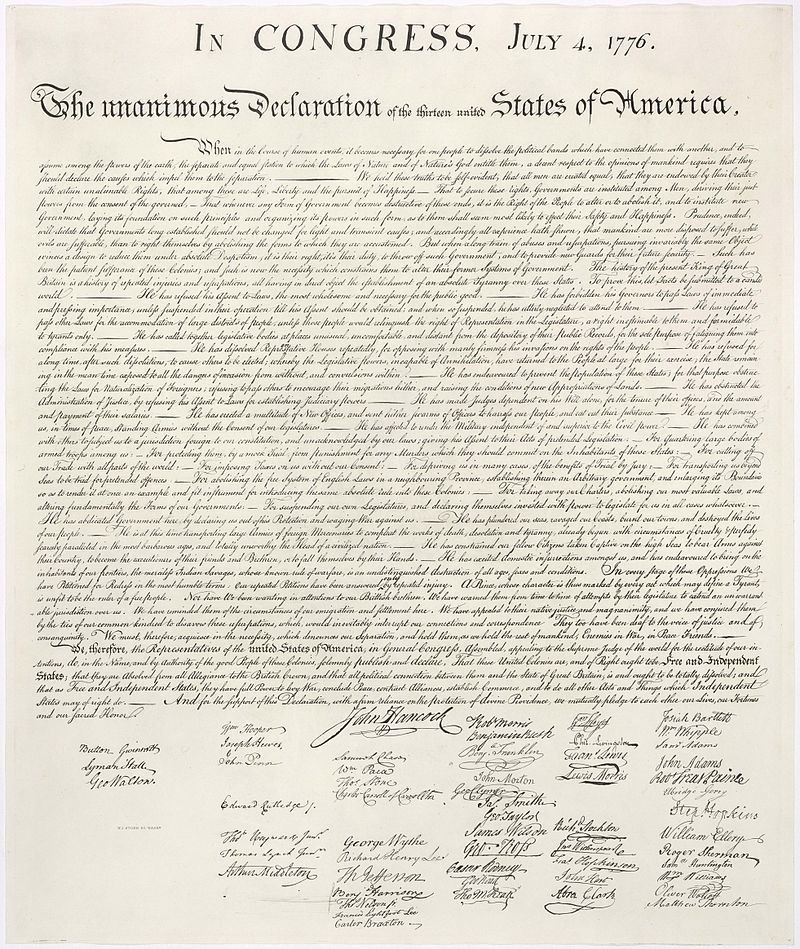
By original: w:Second Continental Congress; reproduction: William Stone – numerous, Public Domain, https://commons.wikimedia.org/w/index.php?curid=621811

The English colonies in America began with land grants made by James I to the London and Plymouth Companies, and developed as business entities managed by shareholders or proprietors in the pursuit of financial gain. Georgia, the last of the thirteen colonies to be chartered, proved to be the exception. Its founder envisioned it as a place where debtors and the “worthy poor” could flourish, though the Crown was more interested in its value as a buffer between Spanish-held territory to the south and its income-producing colonies to the north.

In the beginning, the American companies – whether the Massachusetts Bay Company or the Virginia Company or Lord Baltimore’s Maryland province – were in competition with each other. But as the decades (and centuries in the case of Virginia and the New England colonies) rolled by, their people increasingly recognized their common interests and bemoaned their common injuries.

When representatives of the thirteen colonies assembled in congress on July 4, 1776, they issued a very solemn Declaration of Independence from the British Crown. But before declaring the colonies to be “free and independent states,” the signers emphasized that they were in unanimous agreement as the “thirteen united States of America.”

The representatives recognized their own limitations. They understood that they could not successfully declare their independence from Great Britain without acknowledging their dependence upon one another. Independence from a greater power requires dependence upon another power, whether the collective power of individual states or the ultimate power of a divine being. The founding fathers acknowledged their dependence upon both.

How could Virginia, Pennsylvania or New Jersey stand alone in their independence from Great Britain? They could not. They could only achieve independence through a right and proper dependence upon one another.

This principle that independence is gained through dependence proves true in a variety of contexts. The addict’s independence from the substance or behavior that controls him requires dependence upon an accountability partner or support group and on divine assistance. Independence from an abusive spouse or parent will require dependence upon caring friends and counselors. Independence from mom and dad requires dependence on employers and hard work.

There is no such thing as absolute independence among finite, and therefore dependent, beings. Independence is, and must always be, relative. The man who fancies himself completely self-reliant only fools himself. He is utterly incapable of making his own heart beat or extending his life one minute longer. To such a man St. Paul asks, “What do you have that you did not receive? And if you did receive it, why do you boast as though you did not?”

This is something that is hard for us, schooled as we are in rugged individualism, to remember. We see it across the spectrum of American life. Republicans and Democrats think that they can govern independently of one another. The one-percenters think they can do without the rest of the country, and the rest of the country thinks it can do without them. Racial and ethnic majorities and minorities alike flout one another.

While independence from a hostile power may require dependence upon a friendly one, it is still necessary to use caution in choosing the “friendly power” upon which we rely. Unless it frees us (individually and as a nation) to fulfill our potential, we have chosen the wrong power. That freedom is one God routinely grants and I, for one, gladly declare my dependence on him.

Posted in In the News, Worldview and Culture | Tagged , , , , | Leave a comment

The Bedrock Upon Which Racism Is Built

The author, activist, and preacher Jim Wallis has called racism America’s original sin. Racism is, indeed, an ancient and ugly sin. It is a sin that is even more heinous when it occurs in the Church of Jesus Christ in whom there “is no Greek or Jew, circumcised or uncircumcised, barbarian, Scythian, slave or free, but Christ is all, and is in all.”

Yet I think Wallis is wrong to identify racism as America’s original sin. There is an even older one. It was here before our “more perfect” – though never perfected – union was formed. There is greed.

When I was in elementary school (and, later, junior high and high school), I liked history classes. History texts and history teachers told stories, interesting stories that affirmed my place in the world as an American. Before I left elementary school, I understood that our forefathers and foremothers heroically left their homes and journeyed here to gain their religious freedom.

While this is true it is not the entire truth. Whatever the reason our particular forefathers and foremothers came here, many of them were able to come because their presence in the new world proved economically advantageous to the Crown and to the leading business interests of England, France, Spain, and the Netherlands.

Mercantilism, the reigning economic policy in the western world for three centuries, proposed that wealth (and therefore security) depended on increasing exports and decreasing imports. A nation could only achieve economic security by discovering and claiming new lands and developing their resources.

It was also necessary to people these new lands. Resources were of no advantage if they remained in the ground. Trees must be cut, precious minerals mined, coffees and teas and, later, tobaccos, harvested. This required workers. Lots of workers.

The English colonies in America were founded with land grants made by James I to the London and Plymouth Companies. These were developed as business entities, owned by shareholders, and managed for financial profit. The new land held out the promise of staggering profits to a tiny group of investors.

Georgia, the last of the thirteen British colonies to be chartered, proved to be the exception. Its founder envisioned it as a place where debtors and the “worthy poor” could flourish. Historians, however, suggest that the Crown was more interested in Georgia’s value as a buffer between Spanish-held territory to the south and the income-producing colonies to the north.

The slave trade, and the despicable injustices that went along with it, occurred in the context of international business interests pursuing profits with the support of governments that were maneuvering for economic advantage. Knowing this, one might think that America’s original sin was greed.

However, greed itself is not an original sin. It feeds off insecurity and fear. The seventeenth century’s frenzied struggle for national supremacy was based, at least in part, on fear: fear the Catholics would win – or the Protestants. Fear the French would take the Rhineland, the Spanish would dominate the seas, and the English would wrest control of Africa’s west coast from the Dutch. When fear reigns, people are treated as tools of acquisition and enough is never enough.

Even after descending through the strata of racism, greed, and fear, we have not yet reached the bedrock of our sin. Fear, which has plagued humanity through all its generations, was born of people’s alienation from each other and, more fundamentally, from God. The original sin was not racism or greed but humanity’s rejection of its creator.

St. Paul wrote about this in his magnum opus, the Letter to the Romans. “For although they knew God,” he wrote, “they neither glorified him as God nor gave thanks to him, but their thinking became futile…” This was not only a step away from God but away from each other. What follows in Paul’s letter are the ways humans degraded each other and dishonored themselves.

America is now paying attention to racism. Good. May healing come out of it. But pulling down statues and defacing images will not bring the God-dishonoring, human-devaluing sin of racism to an end. Only reconciliation with the reconciling God, which leads to love and respect for one another, can accomplish that.

First published by Gatehouse Media.

Posted in Christianity, Faith, In the News, Worldview and Culture | Tagged , , , | Leave a comment

It Is Time for a New Creation

The Bible claims that there is a fundamental reality to people that is not immediately apparent. The truest thing about any person is not something that can be seen. There is a self behind the public self. Of course no one would deny this, but there is also a self behind the private self.

We only catch glimpses of our true self but God sees it plainly. It emerges, inevitably and unavoidably from the heart, the core of the human being. On the Day of Judgment what a person really is – the self behind the self – will finally and undeniably be revealed.

Until then, we judge people by their education, wardrobe, and even their “cool quotient.” Or we judge them by their theology, church attendance, or other criteria. We assume we know them; sometimes that we know them well. But we are unable to see what the Bible calls the “inner person” (literally, “the inside man”). Only God sees that.

St. Paul had to learn that lesson. As a Pharisee, he had judged Jesus by standards like education, accent, and “cool quotient.” He later admitted that his judgment of people, even Christ, was based on “a worldly point of view”; that is, on appearances. But Paul learned how unreliable such a gauge is.

He stopped judging people by appearances. He had made that mistake with Jesus, but he would make it no more. Something had forever changed the way he looked at people.

That something, he said, was the astonishing love of God, made visible in Christ. Paul had come to believe that the central event of human history, the hinge on which the whole world turns, is the death and resurrection of Jesus. He regarded it as the most important thing that ever happened to the world and, whether one realizes it or not, to every one of us.

Paul had thought deeply about this and had come to conclude that through the advent of Jesus God was changing the very nature of reality. He saw Christ’s death and resurrection as tantamount to (and prophetic of) the death and resurrection of the cosmos. This truth broke on him like the sun breaks over the horizon at dawn. In its light everything else took shape.

Paul once sized people up on the basis of their orthodoxy, their morality, and their stand on the finer points of religious law. All that changed when he recognized Jesus as Lord and committed himself to him. Even orthodox doctrine took a back seat to a person’s commitment to the Lord of Creation.

In this new light, Paul could see that Jesus was more than Israel’s messiah. He was the world’s transformer. As creation had once come about through his instrumentality, a glorious new creation, promised in the Old Testament, would once again come through him.

Scientists say that the universe came into being in an instant from a single point, sometimes referred to as a singularity. The Bible, however, tells us that the universe came into being from a single person. Christ is the singularity out of which the first creation sprang and from which a new creation is emerging. He is the door between the spiritual and the material, the eternal and the temporal. And the door is open.

Though the new creation has not yet appeared, the apostle found harbingers of its arrival in the people Christ is making new. Whenever anyone enters into union with Christ through faith, it may truly be said that they are a new creation. In Paul’s words: “If anyone is in Christ, he is a new creation.”

Paul’s own Greek comes in a kind of joyous staccato: “So, if anyone in Christ – new creation!” One can imagine him pointing with delight to people whose lives were being transformed through union with Christ. Each time he saw someone from the Jesus community forgiving an offender, loving a stranger, standing up for the oppressed, or sacrificing for the needy, he saw a harbinger of the just and beautiful creation that is coming.

I wonder what he would see if he looked at us.

First published by Gatehouse Media

Posted in Peace with God, Spiritual life | Tagged , , , | Leave a comment